
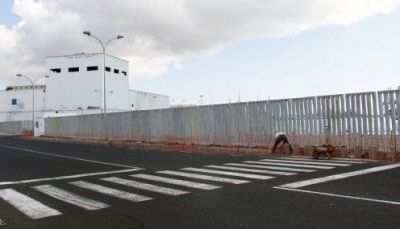
The Criminal Court number 3 of Arrecife has sentenced the legal representative of Homiconsa, Miguel Morales, to one year and six months in prison for a crime against industrial property in the Puerto Naos fencing work, for having plagiarized a model owned by another company. In addition, the engineer in charge of the work, Rafael Corujo, has also been sentenced to the same penalty.
The magistrate responsible for judging the case, Aitziber Oleaga, has considered it proven that the accused copied the model (the so-called Sagrera) from the company Escofet, which is also identical to the one that currently protects the perimeters of the Port of La Luz and Las Palmas in the capital of Gran Canaria and Puerto del Rosario in Fuerteventura.
The judicial authority does not pronounce on whether there is also a violation of the right to industrial property on these islands as it is not within its competence, although it invites Escofet to "proceed to investigate what has happened in Fuerteventura and Las Palmas de Gran Canaria with the possible imitation of its fence".
Likewise, the magistrate warns of the possibility that a security flaw detected in the Puerto Naos fence, which could endanger the lives of children, has been reproduced in Puerto del Rosario and Las Palmas, since, according to an expert, a small child's head would fit through the gap.
In addition to the criminal sentence, the sentence imposes on the legal representative of the companies Hormigones y Construciones Arrrecife and Hormiconsa, Miguel Morales, and the engineer Rafael Corujo, fines of 6,000 euros each and the obligation to compensate the plagiarized company with 80,182.14 euros as direct civil liable parties. Likewise, Hormiconsa Canarias S.A. and Hormigones y Construcciones Arrecife S.L. are held subsidiarily liable for the payment of this sum.

In the case of Morales, it should be remembered that he already has another previous conviction for a crime against land planning and another of serious disobedience to authority, for having built three warehouses, a concrete plant and a crusher on protected land in Arrecife, without even having requested a license and having even violated a sealing order from the City Council.
The contest
The judgment declares it proven that in November 2009 the Port Authority of Las Palmas presented for tender the award of Phase I of the project consisting of fencing the operations area and control post in Puerto Naos. In this project, it continues, the placement of a perimeter fence was planned with the specification that the fence should be the Sagrera model from the company Escofet or similar.
As a result of this offer of contracting through a public works tender, a large number of companies aspired to the award, including Miguel Morales and the companies of which he was a joint administrator, Hormiconsa and Hormigones y Construcciones Arrecife, and the technical engineer of Hormigones y Construcciones de Arrecife, Rafael Antonio Corujo Gil de Montes.
According to the ruling, both defendants requested a quote from Escofet for the supply of 107 units of the Sagrera fence, that is, the number of units planned in the project submitted to tender, with Escofet valuing the purchase at 66,875 euros.
In the budget that was sent to those now convicted, Escofet's attorney expressly warned them that the company held "ownership of the exploitation rights of the intellectual or industrial property rights over the products" that constituted the offer, warning of the "prohibition of their manufacture, commercialization and promotion", as Escofet held a community design registered in the Office for Harmonization in the Internal Market (OHIM). However, on November 26, 2010, the contract was awarded to Hormiconsa, "having offered the lowest price".
Warned by Escofet
In September 2011, the legal representation of Escofet "became aware that the defendants had executed the awarded work by placing a fence that was clearly a substitute copy" of its Sagrera model, originally planned in the work project awarded by the Port Authority of Las Palmas to Hormiconsa, "since the common elements are more relevant than the differences, in that both fences contain as similarities the general dimensions, the specifically broken design to give the sensation of movement of the vertical posts, the fitting system between the modules, the connecting strap of the vertical posts at its upper limit, as well as the foundation and delivery system with the pavement".
The judicial resolution also recapitulates that, once Hormiconsa's action was verified, on November 11, 2011, through its lawyer, Escofet sent a letter to Hormiconsa informing it that it had become aware of its action, "that is, that in the fencing of the operations area of Puerto Naos, in Arrecife, the recipient of the letter had been in charge of the works and that in doing so it had copied the Sagrera fence, the ownership of whose design, as it was aware, belonged to Escofet (?) "informing it that such action constituted, in effect, a clear violation of such rights owned by the plaintiff and that, on the one hand, if it did not cease the manufacture and installation of the copied fences and, on the other hand, compensated for the damages it had caused, it would undertake the appropriate legal actions", as has happened.
Five expert reports
In her 50-page judgment, Magistrate Aitziber Oleaga, after taking into consideration the five expert reports that were provided to the case, reaches the "full conviction" that the Puerto Naos fence is a "substitute copy" of the Sagrera fence of Escofet, "since both coincide in their common elements, which are those that must be taken into account by the observer".
"It is not necessary to analyze that each fence in particular has subtle differences in size and composition of the beams (which on the other hand only differs in one), but to assess the composition that constitutes the totality of the fences, that is, the fencing as a whole and, for this, it is necessary to take into account the definition of the Escofet fence made on its website, (?), it fully coincides with that of Hormiconsa when observed by any person, whether or not they are knowledgeable in commercial designs or architecture, it is not necessary to be a specialist to realize that they are similar or, if preferred and, in terminology coined by the Supreme Court itself, a copy, because there is no doubt that Hormiconsa, not being able to assume, according to what it refers, the costs of the Sagrera Fence, which also, would have had to be brought from Barcelona, opted to manufacture it in a similar way", details the judge.
It has a "security flaw" that can be a danger to children
On the other hand, the judgment emphasizes that, as explained by an expert during the oral hearing of the trial, in the fence executed by those convicted, the one that currently protects the perimeter of the Port of Arecife, there is "a security flaw" in terms of the distance between the beams, as it did not respect the measure of 12 centimeters, but has 13.5.
In this regard, the judge points out that the expert who warned of this flaw explained that this distance should be reduced "in order to prevent a child's head from being inserted between them [the beams] and getting stuck with danger to their physical integrity or even their life".
"It would be necessary for the port authority to verify this circumstance in order to avoid any future misfortune, because despite how strange or incredible it may seem, the heads of children or even their entire bodies can fit in extremely small spaces that, a priori, seem impossible for this to be the case, and for example the unfortunate event of the child Julen whose case shocked the national, even international, community, who died as a result of having fallen into an unsealed well of very small dimensions", points out the magistrate
The ruling also points out that it remains "in the hands of the plaintiff" to proceed to investigate what has happened in Fuerteventura and Las Palmas de Gran Canaria with the possible imitation of its fence, "although, what would be desirable in any case, is that said fences placed in other places, at least comply with the safety measures between beams (?) in order that the children of several islands of the archipelago do not run any danger". The judgment, however, is subject to appeal before the Provincial Court of Las Palmas.
Add La Voz de Lanzarote as a preferred Google source.
Stay informed with the latest current news.


