
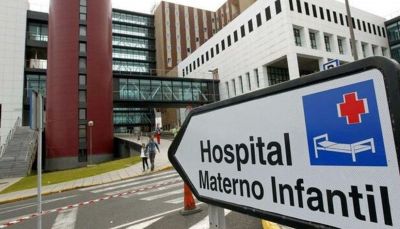
A court in Las Palmas de Gran Canaria has issued a pioneering ruling in Spain that recognizes the "fundamental right" of a pregnant woman to choose between natural birth or cesarean section and condemns the Canary health service to compensate a mother with one million euros for prolonging a twin birth for 17 hours, considering it an act of "obstetric violence."
In a ruling to which EFE has had access, the Contentious-Administrative Court number 5 of the city rules that, by imposing natural birth on the mother, the doctors of the Maternal and Child Hospital of Las Palmas de Gran Canaria did not respect the mother's "fundamental right" to decide whether she wanted her twins to be born vaginally or by cesarean section, causing irreversible brain damage to one of the little ones.
Magistrate Ángel Teba García thus fully upholds the lawsuit filed by Acosta y Navarro law firm on behalf of the affected party against the Canary Health Service, "given the flagrant violation by the intervening physicians of the right to information that was the exclusive right of the parturient woman and the inalienable right to opt for cesarean section as a surgical alternative to give birth to her two babies."
The ruling considers that the woman was not informed "of the circumstances in which her delivery was taking place, nor of the advantages or disadvantages, dangers and risks of natural birth versus cesarean section, so that she, correctly informed, under her responsibility, could opt for one or the other possibility."
In this case, the judge reasons, "what is observed is the imposition 'contra legem' (against the law) of the medical criterion that the appellant give birth by natural delivery, subjecting her and the two fetuses to an exhausting natural delivery that lasted a whopping 17 hours and with a disastrous result with which the mother and her son, as well as her twin sister, must bear, and that no amount will ever be able to compensate."
The ruling accepts the arguments of the lawyer who defended the mother in the process, Javier Navarro Betancor, and confirms that the actions of the doctors at the Maternal and Child Hospital incurred in an "inadmissible usurpation of another's right" that has resulted in "a terrible result, caused by those who stole the possibility that (the mother) could opt for a cesarean section in due time, avoiding any injury to her son."
The judge defends that the right of the pregnant woman "to be informed of the existing alternatives, with their pros and cons, to give birth" assists her "during gestation, before giving birth, when the process began, throughout it and until the very last moment of giving birth."
And he reproaches the Canary Health Service for "a patriarchal conception of women, disdainful of their capacity for self-determination even when enshrined in the Law, dismissive of their competence to decide once correctly informed, which aborts any autonomy they might have and which can be described without ambiguity as obstetric violence."
The Canary Health Service argued in the trial that the final decision between natural birth or cesarean section corresponds to the obstetrician and that it will be this medical professional who will have to assess the circumstances in each case to decide on the matter.
"The final decision is not the doctor's but the patient's"
The ruling rejects that argument: "the final decision is not the doctor's but the patient's, under her responsibility, once correctly informed of her situation and of the existing alternatives, in this case natural birth or cesarean section, and assures that the opposite is to circumvent the rights that the Law recognizes to patients, in this case to any woman who is going to give birth."
The magistrate who dictates it concludes that "what happened in the case at hand was the 'manu militari' imposition of the medical criterion of the doctors who attended the appellant, who, in their professional work, do not contemplate any alternative to natural birth and therefore failed to inform, in writing, the mother during the lapse of 17 hours, of the alternative that constituted the cesarean section and of the advantages and risks that it implied.
The resolution recalls that the Canary Health Service has been ordered to pay large compensations in similar cases, which it warns "should not be borne by the Canary taxpayer but by those doctors who transgress the law in pursuit of the primacy of natural birth above any circumstance."
In this sense, the judge specifies that it is up to the Canary Health Service "the exercise of the right of repetition against these professionals" so that the economic costs fall on "those who are truly responsible for the damage"; that is, the doctors who decided to continue a natural birth that ended up causing very serious neurological injuries to a newborn.
"The minor was born with a degree of disability of 83% and with a physical, psychic and sensory impairment"
In setting the compensation at one million euros, plus interest, the magistrate reasons that it is a minor born in 2016, who has been recognized a degree of disability of 83% and suffers a physical, psychic and sensory impairment resulting from the neurological injuries received that have "completely truncated his life project", because he will require continuous and costly medical attention.
He points out that the situation of the minor also completely conditions the life of his mother and his twin sister, which now "has a very different character than it would have taken if the infringement had not occurred" by the doctors of the Canary Health Service.
This ruling can still be appealed to the High Court of Justice of the Canary Islands


