
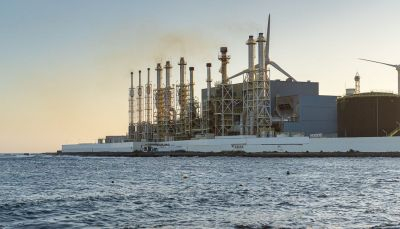
Macaronesia, made up of the archipelagos of Madeira, Azores, Cape Verde and the Canary Islands, has a foreign energy dependence of 93%, and the production of electrical energy using conventional sources is mostly produced with oil derivatives.
This implies a high additional cost compared to continental systems, a fragility regarding the volatility of international fuel prices and high logistics costs to bring the fuels to each island, according to the Macaronesia white paper, presented this Tuesday in Tenerife.
In this book, which carries out a diagnostic report for the strengthening and integration of the value chains of Macaronesia in common economic sectors with high added value, it is concluded that the high dependence on fossil fuels results in a high environmental cost, reflected in high emission rates per MWh produced.
All of this, it warns, "greatly hinders the decarbonization objectives" on the islands of Macaronesia, which have isolated electrical systems and, in the case of some systems, more than 32 energy zeros are reached per year.
Likewise, according to the white paper, Macaronesia has a high dependence on tourism as an economic activity, which implies a floating population that requires greater energy resources than the general population.
Although the four archipelagos have all these points in common, in relation to the weaknesses presented by their electrical systems, each one has its own peculiarities.
Energy threats and strengths of the Canary Islands
According to the white paper, the main threats to the Canary Islands are the social and regional opposition of island governments to the integration of large wind farms and photovoltaic plants, as well as the lack of a specific development plan to regulate a Canarian energy and storage market.
Regarding weaknesses, the book refers to the existence of electrical systems dependent on the import of fossil fuels in a high percentage and that the islands have a great electrical demand due to their population and tourist pressure.
It also warns that, with the exception of Gorona del Viento, in El Hierro, there are no more large-scale storage projects in the short term, and that the local administration and procedures hinder the development of renewable projects.
Among the strengths of the Canary Islands are the development of self-consumption and energy communities, and that there is both political will and budget items for "important" subsidies.
According to the white paper, the Canary Islands have offshore wind power with great potential, and a key hydrogen economy to guarantee high quotas of renewables in the energy mix.
The Professor of Applied Economics at the University of La Laguna (ULL), José Luis Rivero, has participated in the colloquium on the challenges of Macaronesia, and has pointed out that small island economies such as those of Macaronesia have to base their economic activity on what are called "absolute advantages", such as climate, tourism and its geographical positioning.
He stated that these economies have a problem related to their small size and their distance from large markets, which should be addressed "in order to take sufficient advantage of the opportunities that arise."


