
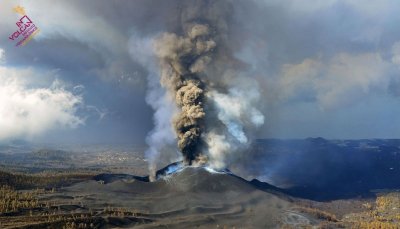
The plenary session of the Parliament of the Canary Islands has unanimously approved the Volcano Law, a regulation that emanates from popular initiative and processed in the legislative chamber, the first volcano law in Spain, which emerged in La Palma after the eruption in the autumn of 2021.
The Volcano Law seeks to guarantee, accelerate, and provide legal certainty to the social, economic, environmental, and housing recovery after a volcanic eruption, which in a land like the Canary Islands, no one doubts will happen again.
The spokespersons of the parliamentary groups agreed to praise the popular origin of the regulation and the political consensus for its approval, although the deputy of the PSOE, Alicia Vanoostende, was very critical of the response of the Government of the Canary Islands and the Cabildo of La Palma in the last two years, which "is not up to the standard of the people of La Palma".
"There is no worse deception than that which is done to vulnerable people," denounced Vanoostede, whose group unsuccessfully maintained an amendment to ensure transparency and to know which people receive public aid.
People "are still waiting for a response", the central government "has a firm commitment to recovery", but farmers, residents of the exclusion zone, still have doubts about how the funds have been distributed, and it is hidden who the aid has gone to, we want light and stenographers", said the representative of the PSOE, who demanded that the Canary Islands executive "not continue to use the pain of a people to do politics".
The rest of the spokespersons focused their interventions on praising the Volcano Law, and thus Jonathan de Felipe, from CC, recalled that those affected found themselves facing an eruption without a legal regulation that would allow them to face it and they themselves are "the ones who give the Canary Islands a regulation like this", to face new eruptions and to apply it in the case of Tajogaite in everything that is compatible.
The deputy of the PP, Raquel Díaz, commented that it will never be forgotten that the Tajogaite "destroyed stories and memories" against which, although "we did not have a manual, the reaction became an example of public management and institutional solidarity".
"We cannot stop the lava or alleviate the pain, but we can take advantage of that experience to provide ourselves with a legal framework that protects everyone and helps in the future to recover life projects," she explained.
The spokesperson for Nueva Canarias, Luis Campos, stressed that this popular initiative demonstrates that society is always ahead.
However, he stressed that in the face of the Tajogaite eruption "much was done, although insufficiently and more slowly than appropriate, hence the need for this regulation: to learn from mistakes and consolidate what was done well".
Javier Nieto, from Vox, recalled that the citizens of La Palma still have unresolved problems and wounds that have not yet healed and defended that although this law does not solve everything nor is it a panacea, it does demonstrate the importance of consensus to find solutions and get closer to the problems of citizens.
Jesús Ramos Chinea, from ASG, stressed that this regulation is an example that synergies can be created between the people and the Parliament for the benefit of all.
The deputy of AHI Raúl Acosta Raúl Acosta (AHÍ) stressed that the law emanates from the people and connects with citizen participation in politics, while it has been enriched in parliamentary processing through the contribution of all groups.
The new regulations definitively approved this Wednesday seek to provide the autonomous community with a comprehensive, agile and coordinated response that improves recovery processes in the event of new volcanic eruptions and guarantees the rights and compensation of those affected.
The sufficiency of aid to those affected, the recovery of homes and economic activities, the coordination of administrations in their responses and the elimination of bureaucracy are aspects on which the Law focuses to speed up reconstruction in the event of a volcanic catastrophe.
The reconstruction includes the social, economic and environmental recovery of the territorial space affected by the eruption and the lava flows, but also of the island as a whole.
In particular, it is intended that those affected can return to settle in the same place where their properties were located, or as close as possible, but also that they recover their life and activities or their agricultural or livestock farms.


