
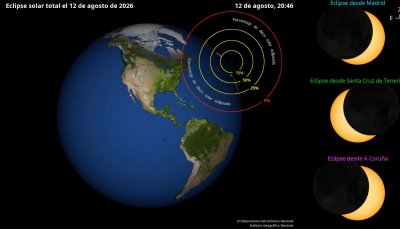
The Canary Islands are counting down the hours to experience the total solar eclipse on August 12, 2026, although it will be seen partially from the archipelago. This eclipse will be the first visible since 1959, for which ten cosmic watchtowers will be available on the eight islands and the documentary Eclipse for Spanish planetariums, directed from the Elder Museum, in order to "promote astrotourism and disseminate science."
In statements to the media this Tuesday, astrophysicist Fernando Jáuregui, who will coordinate the informative documentary, explained that this solar eclipse "will be one of the most wonderful natural phenomena that can be observed," because it will be "very close to the horizon."
In the Canary Islands, it can be observed as a partial eclipse, but in the Iberian Peninsula it will be total and there will be "a very strange and beautiful summer late afternoon," since "it will get dark before the sun sets and it will dawn with the sun about to set," followed by a twilight, partially eclipsed, that will compete with the decrease in luminosity and the rising of the moon.
To culminate the astronomical moment, once it gets completely dark, the maximum of the Perseids will be reached to close a "total spectacle" that "no one can miss," Fernando Jáuregui highlighted.
"In this case, it is an eclipse that is already very close to nightfall, the shadow passes close to the surface of the earth and will not be one of the longest. In the Peninsula, the longest view will be around 1 minute and 45 seconds. It will have diamond rings, Baily's beads and a very special play of lights with that twilight," he detailed.
The peculiarity of the solar eclipse on August 12, 2026 is that it will be accompanied by two more on August 2, 2027 and January 26, 2028, which can be seen from the Iberian Peninsula, a concatenation of three that has motivated Spanish planetariums to undertake the 'Eclipse' project.
Regarding the documentary piece, which is expected to be available by the spring of 2026, its coordinator explained that it will "show the population that science is something that is worthwhile" and that the acquisition of the disseminated knowledge will allow "the fun to be complete with the beauty of the natural phenomenon."
With the aim of facilitating the vision of the natural phenomenon, the Elder Museum of Science and Technology will install ten cosmic watchtowers on the eight islands, all oriented towards the west so that around 7:30 p.m., the peak moment of the eclipse, the view "is as clear as possible," said the museum's astronomer, Gregorio de la Fuente.
In Gran Canaria you can go to the watchtowers of Arucas and Tejeda, in Tenerife they will be in Puerto de la Cruz and Playa San Juan, in Lanzarote it will fall on La Santa, in Fuerteventura it will be available in El Cotillo, in La Palma it will be seen from Tazacorte, in La Gomera you will have to go to Valle Gran Rey, in El Hierro to Frontera, and in La Graciosa from Caleta de Sebo.
The director of the Elder Museum of Science and Technology, José Gilberto Moreno, has detailed that more than 300 activities will be organized before August 12, 2026 and they will have interactive workshops from the month of September in the museum, as well as disseminations in the 88 municipalities of the Canary Islands to explain what the solar eclipse or the Starlight denomination means.
"We are talking about one of the most important astronomical events, which can almost only be seen once a century. We must prepare it well in advance and we will work to make the world of astronomy the main axis of the development of the Elder Museum in 2026," Moreno anticipated.
To put the dimension of the phenomenon into context, the top manager of the Elder Museum has said that there is an interministerial commission to manage the organizational challenge posed by the solar eclipse and analyze the suitability of declaring August 12, 2026 as a holiday.


