
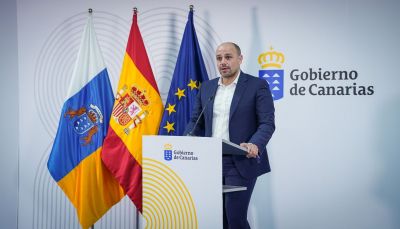
The Canary Islands Government approved this Monday the communication in which it proposes legislative changes for the mandatory referral of migrant minors since, according to its spokesperson, Alfonso Cabello, if the amnesty is "good, necessary and urgent, how can it not be to attend to the 5,600 minors" who have arrived in the Archipelago.
The communication has been approved at the meeting of the Governing Council and will be sent this Monday to the Parliament of the Canary Islands so that, depending on the calendar agreed by the Bureau of the institution, it will be included for debate this month, presumably in the plenary session of February 27 and 28, before the debate on the state of nationality.
In this way, the document will be enriched with the contributions of the parliamentary groups and the resulting text will be sent to the Congress of Deputies, together with an invitation for the spokespersons of the groups to visit the centers for unaccompanied migrant minors and the arrival points at the foot of the dock in the islands.
This is "the roadmap" marked from the first moment by the regional Executive, a "Canarian solution", as defined in a press conference by the spokesperson Alfonso Cabello, who pointed out that the modification of article 172 of the Civil Code is requested for this objective through the decree law, just as the Spanish Government has done "on 138 occasions" previously.
The aforementioned article of the Civil Code is "the one that makes it impossible" for the State to take guardianship of the minors when they arrive in the Canary Islands so that they can then be distributed in other regions, since the guardianship corresponds to the Autonomous Community to which they have arrived, explained the Canarian spokesperson.
In this matter, the Canarian Government is trying to have a "clear" strategy based on dialogue and consensus "and avoiding the noise generated at the political level in the state sphere", Cabello continued, to also warn that the Canary Islands "complies" by providing economic and technical resources, but "cannot wait any longer, it also needs the State to comply".
"Enough of excuses: what is needed is to put on the table a response so that minors are cared for in the most agile way possible, not out of solidarity, but out of co-responsibility with the work that the Canary Islands is doing in health care and with an integration project, something complicated in a fragmented territory," Cabello added.
In turn, the regional vice president, Manuel Domínguez, has admitted that the cabinet is "very" concerned that only four communities have responded to the agreement last October to refer 347 minors who arrived on the islands, something that has been gaining "some dynamism" but not fast enough for the migratory reality that the islands are experiencing.
In this regard, the spokesperson for the Canarian executive has specified that in January 902 unaccompanied minors arrived on the islands and in the 12 days of February that have passed, migrants have arrived in the archipelago, to remember that the migratory flow is already structural and will be a constant throughout the coming months and in the face of this situation "we need a solid response from the State".
The spokesperson, who has admitted that the round of contacts with all the communities continues but to date "no departure" of migrant minors has taken place, has acknowledged that the regional Executive is also watching the political situation in Senegal with concern.
In addition, the Canarian Government will inform the State of the agreement that the regional Parliament adopts in this area, according to the spokesperson, after emphasizing that the Minister of Youth and Childhood, Sira Rego, has committed to "give a response to the Canarian solution before March 31".
The main objective of the Government's communication to the Parliament of the Canary Islands on unaccompanied non-EU minors is to "safeguard and promote the rights of minors, regardless of their nationality or migratory status", based on the Child and Adolescent Protection System recognized internationally and nationally.
This proposal considers it urgent to "establish a coherent and effective legal framework that ensures that unaccompanied migrant minors are treated in accordance with their rights, guaranteeing their access to protection and adequate care".
For the Government of the Canary Islands, the current number of minors "makes it impossible" to fulfill these guardianship obligations, including "social integration".
The text that the Parliament will now debate contemplates several ways of modifying the current regulatory framework through which the distribution of unaccompanied migrant minors throughout the Spanish territory can be guaranteed.
The Government of the Canary Islands prefers that article 172.1 of the Civil Code and the Framework Protocol be changed, since it can be addressed through a decree law approved by the Council of Ministers that should then be endorsed by the Cortes Generales, as the fastest solution.
As alternatives, the communication elevated to the Regional Chamber provides other legislative changes that are "more onerous, complex and slow" as they are modifications of organic laws, whose approval requires to be processed and endorsed by an absolute majority in the Congress and the Senate.
Specifically, modifications to the Immigration Law, the Legal Protection of Minors Law and the Immigration Decree would be necessary.


