
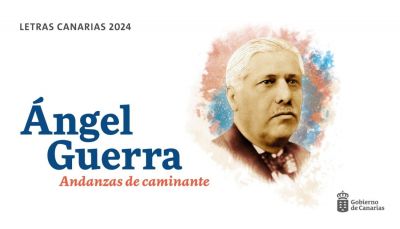
The Canary Islands Government Council, at the proposal of the Minister of Universities, Science and Innovation and Culture, Migdalia Machín, has approved this Monday, January 29, to dedicate the Canary Islands Literature Day in 2024 to Ángel Guerra (1874-1950), coinciding with the 150th anniversary of his birth.
Writer, politician, and direct disciple and friend of Benito Pérez Galdós, the writer from Lanzarote shapes the prism of a complex personality with a democratizing will, who developed within the great literary personalities of the time. His literary work can be framed within the naturalism and realism of the early 20th century, in which he stood out for his narration of the life of the working classes dedicated to the sea, a central element in his work. Thus, Ángel Guerra will take over from Félix Francisco Casanova, the protagonist during 2023.
The election of this author will be an opportunity to recognize and disseminate his work, through various activities that will take place throughout this year. The program of initiatives planned for 2024 will begin on February 21, at 7:00 p.m., with an institutional event at Jameos del Agua. The event will be led by the artistic director Quino Falero and will feature various adaptations of his work that will be represented through dance, music, and theater. Public attendance is open, until full capacity is reached. It can also be viewed via streaming on the YouTube channel 'Apúntate a la Cultura' and the Facebook account 'Día de las Letras Canarias', both managed by the Vice-Ministry of Culture.
Among the actions that will be carried out throughout the year, is the re-edition of 'Canarian Stories', a compilation of texts that exhibit his vision of the archipelago, as well as the launch of a monographic magazine with articles in which different literary authorities will review his work. On the other hand, the Government of the Canary Islands will provide educational centers with an adapted school edition and an itinerant exhibition about the author will be organized, which will reach the entire archipelago. These will be the first proposals of a program that will last throughout the year, and to which the Government, councils, city councils, as well as public and private entities from all over the Canary Islands geography are added.
Since 2006, the autonomous government has consolidated the celebration of Canary Islands Literature Day on February 21, which begins a year of recognition of the various literary figures who have contributed to the construction of Canarian identity. The choice of this date coincides with the death of José Viera y Clavijo in 1813, to whom the first edition of Canary Islands Literature Day was dedicated.
Ángel Guerra
With the election of Ángel Guerra in 2024, the career of a writer who placed the humble people of the Canary Islands at the center, denouncing the poor conditions in which fishermen, farmers and their families lived, and who drew an acid portrait of the Canarian bourgeoisie of the early century, will be recognized. This commemoration will coincide with the 150th anniversary of his birth.
Born in Teguise as José Bentacort Cabrera, he signed his works with different pseudonyms until opting for Ángel Guerra, a name he extracts from the homonymous novel by Benito Pérez Galdós, whom he considered a friend and teacher. Galdós's influence encouraged a social commitment that defined his literary work and that he also manifested by taking the step into political activity. Deputy for the Liberal Party during the Restoration, he was Director General of Prisons in the Republican Government, improving the living conditions of prisoners.
This author from Lanzarote celebrates the 150th anniversary of his birth in 2024. His public recognition is unquestionable, especially after the inclusion of one of his most relevant works, 'La lapa', in the Letras Hispánicas collection, from the prestigious Cátedra publishing house, in 1978. This meritorious fact meant his entry into the literary canon not only Canarian, but Hispanic in general.
His career is not limited exclusively to the literary field, as he also dedicated himself to journalistic work, the translation of texts, literary criticism and politics. He began working as a teacher at the Arrecife school, before making the leap to the world of journalistic chronicles. In 1894, he met Benito Pérez Galdós, a fact that marked his life and led him to adopt the pseudonym of Ángel Guerra, influenced by the novel of the same name that Galdós had published in 1891. This relationship was not merely one of admiration, as he became friends with the writer from Gran Canaria, who welcomed him into his family and literary gatherings. Thanks to this inclusion, he was in contact with Miguel de Unamuno or Emilia Pardo Bazán. Juan Ramón Jiménez was another of his closest friends, who praised the writer from Conejero in the poem "Calma" from his book Ninfeas (1900). In turn, Guerra was appointed to collaborate in the centenary of Benito Pérez Galdós, at the Canario Museum, in 1943.
During his stay in Madrid, he created the Canary Islands Affairs Agency together with the journalist from Tenerife, Manuel Delgado Barreto, in order to help the Canary Islands population with matters related to the capital, such as commercial matters, resolution of files and all kinds of procedures, among many other things.
The request from the Ministry of Universities, Science and Innovation and Culture proposes to value the figure of a multifaceted writer who represents Canarian literature and, in addition, was a great defender of social rights, with emphasis on denouncing the situation of women and the remodeling of the penitentiary system. He also placed the island of Lanzarote within the map of Spanish literature in which the Canary Islands were on the most absolute periphery and contributed significantly to the publication of other Canarian authors, such as Tomás Morales or Pedro Perdomo Acedo.


