
In some recent and worrying statements, Santiago Abascal, leader of VOX, states that the humanitarian rescue ship `Open Arms´ must be sunk. This execrable statement is not only a nonsense loaded with cruelty, but represents a dangerous contempt for a fundamental pillar in the development of civilization: navigation and, therefore, maritime solidarity, in addition to hurting the collective memory of many peoples who, like the Canary Islanders, know closely what it means to emigrate, cross the sea and, in many cases, be rescued from certain death.
The ship has been a symbol of discovery, commerce, interrelation between different cultures. It is not just floating wood or steel: it is an extension of the innate human need to conquer new areas, to seek answers, to overcome their fears, to unite shores separated by the abyss... Faced with that, asking for the sinking of a ship that has saved thousands of lives is asking us to sink as a society. It is invoking death on those who are already fleeing death. It is wanting to drown compassion on the high seas.
From the first boats that we know of, about 10,000 years ago, we remember with admiration those ships that explored the world, but also those that saved those who inhabit it: from those who rescued Jewish refugees during World War II, to those who, loaded with aid, today bring health care and food to regions devastated by natural disasters, wars, or genocides such as the one we are experiencing in Gaza. In this "historical armada" is Open Arms, an organization that, whether certain ¿political? sectors like it or not, has rescued men, women and children who would have ended up at the bottom of the sea.
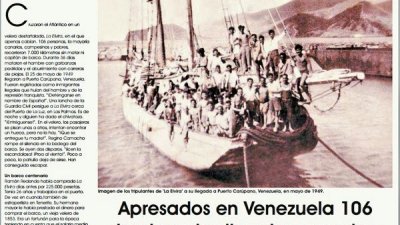
In the Canary Islands they don't have to explain it to us. For decades, thousands of islanders were forced to leave their land in search of a decent future, or simply a future. Our grandparents and great-grandparents left in precarious ships bound for Venezuela, Cuba, Uruguay or Argentina: `Telémaco´, `La Elvira´, `Benahoare´, `San Miguel´... They were the "ghost" ships that supposedly went out to fish and returned under the cover of darkness to embark in hidden and secluded coves those who had made the difficult decision to flee political persecution, intolerance or misery. They were desperate journeys; some shipwrecked, others were rescued on the high seas. And in all cases, what saved lives was the humanity of those who extended a hand, not indifference or hatred.
It is painful that now, when other peoples suffer and escape from war, hunger or persecution —just as we Canary Islanders did—, there are voices that not only deny aid, but ask to sink the ships that offer it. Abascal's words not only criminalize an NGO that acts where the States look the other way; they also reveal a dangerous dehumanization of the other, of the foreigner, of the vulnerable. It is a rhetoric that stinks of moral shipwreck.
Faced with the destructive message of VOX, we must defend the role of ships as tools of progress, cooperation, philanthropy. Sinking a ship is not only an illegal act. In this case, it would also be a crime against humanity. Because, in a world where walls are raised faster than bridges are built, ships like the `Open Arms´ continue to be watchtowers of hope. They are not slave traders, as certain manipulative discourses present them. They are references to the best of the human condition: the ability to help others when they need it most. And on the Canary Islands coasts, where the migratory drama is experienced daily, we know better than anyone that a castaway does not know about papers, ideologies or borders. The Canary Islands have been and continue to be an entry point, a land of transit, islands of hope. It was for those who left and for those who arrive. And that is why it hurts doubly to hear proposals that are more reminiscent of dark times than of a supposedly democratic project.
As Pedro Lezcano said in his poem `La Maleta´:
If the technicians of hatred settle
on our slopes,
the African children, sleepless
under the canvas of their tents,
will look with horror at the seven islands,
not as seven stars,
but as the seven biblical plagues,
the seven skulls
from where their death, and our death,
inevitably are projected.
Who can ask for the sinking of a rescue ship knowing that among the lives saved there are children, pregnant mothers or young people who are only looking for a future? Who can forget that we too were those "undocumented", those "who came by boat"?
Instead of sowing hatred, we need more ships that save, more outstretched hands, more memory. Because dignity, like ships, does not sink. It is honored.
Mario Suárez Rosa
Santa Cruz de La Palma, September 2, 2025
Add La Voz de Lanzarote as a preferred Google source.
Stay informed with the latest current news.