
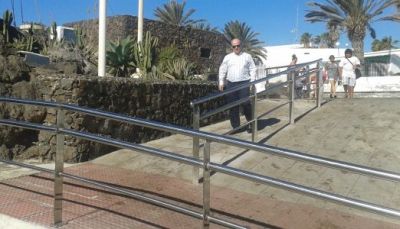
The Tías City Council has undertaken a plan to make Puerto del Carmen an accessible destination for people with disabilities. The tourist town already has several establishments specializing in this segment, but it still did not have beaches adapted for people with reduced mobility.
Since last December, the Tías City Council has been developing improvement works and elimination of architectural barriers in Playa Chica, near the port of La Tiñosa, in Puerto del Carmen. These works will be completed in the coming weeks, as announced this Wednesday by the mayor, Pancho Hernández, in the presentation of this plan.
In this act, the mayor was accompanied by the Councilor for Beaches, Yolanda García, and the one for Tourism, Nerea Santana. Likewise, the first mayor has indicated that in 2014 "some actions" are planned in Playa Grande, which will have an approximate value of 250,000 euros. These works will focus on the improvement of public facilities, the elimination of architectural barriers, new adapted toilets and the creation of ramps.
"First accessible beach in Lanzarote"
The City Council has contracted the specialized firm of Equalitas Vitae for the supervision and elaboration of this accessibility plan, whose director, Izaskun Benito, has been present at the presentation of the initiative, in Puerto del Carmen. This firm will focus, for now, and in a first phase, on the actions to be undertaken on the beach of Los Pocillos, the second largest on the coast of Puerto del Carmen.
As explained by the Consistory, Equalitas Vitae prepares a diagnosis of the current facilities, their shortcomings and new works to be executed. At the end of this analysis, it will grant the accessibility certificate, so Puerto del Carmen will have "the first accessible beach in all of Lanzarote".
Among the services that Puerto del Carmen will have is the availability of amphibious chairs for those disabled or with reduced mobility, who intend to bathe in the waters of the coast of Puerto del Carmen.
According to the Tías City Council, more than 50 million people with disabilities or reduced mobility who live in Europe plan their vacations every year choosing a destination that has public facilities, transport and establishments certified as accessible.


