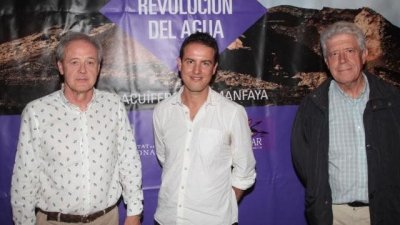
Albert Casas, professor at the University of Barcelona and head of the geophysical study on the Timanfaya aquifer, has issued a statement to "clarify" the information disseminated by some media outlets, which include his statements, and to respond to the interpretation made of those words by the president of the Lanzarote Cabildo, Pedro San Ginés.
In a statement, San Ginés states that "the expectations created by Podemos about the existence of a huge underground water pocket in Timanfaya are based on a mere subjective interpretation" and even accuses the party of having "played with the good name of the University of Barcelona." To do this, he relies on alleged statements made by Casas, who now wanted to publicly clarify his position and the scope of his report, thus reiterating the same messages he already conveyed on Thursday night at the public presentation at the Arrecife Civic Center.
On the one hand, Albert Casas has stressed that "there are more than enough indications to justify the Canarian Government already carrying out the soundings in Timanfaya to determine both the quantity and the quality of the underground water." "We must continue with the soundings because that is how knowledge and scientific progress are built," he insisted.
"A very small investment in relation to the benefits"
Regarding the conclusions of his study, as explained during the presentation, he points out that what it determines is the probability that there is water in Timanfaya, "which is what it was commissioned for," "but without assessing how much or of what quality, data that can only be confirmed by carrying out the soundings."
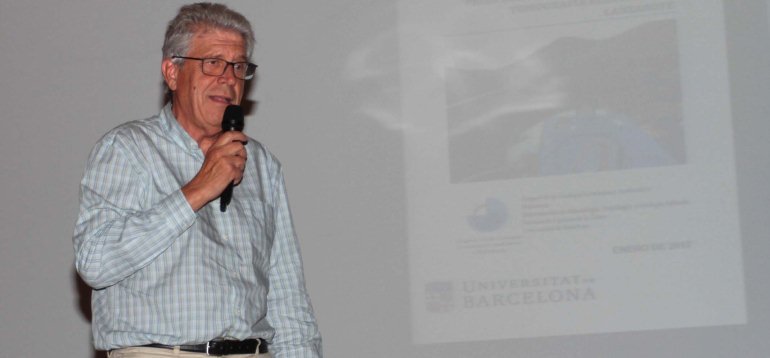
In this regard, the professor explains that it is the other report presented by Podemos, prepared by the engineer Carlos Soler, "which puts on the table some data on the possible amount of water, based on his experiences in other badlands and on his calculation of water evaporation, which he puts at 50% (while the Hydrological Plan has been setting it at 89% since 1975)."
However, Casas also wanted to clarify that "even if there were only 20% of Soler's calculations, it would still be more than justified to carry out the soundings." And he insisted that "we are talking about a very small investment in relation to the benefits that can be extracted from this resource."
Albert Casas also wanted to reiterate, as he expressed this Thursday at the Civic Center, that he shares the enthusiasm for this project, and insisted on the need to address "the successive phases" to be able to determine the scope of "this hidden asset," which could represent "an alternative" for an island that depends exclusively on desalination, with the expense and consumption of energy and oil that this entails.
Add La Voz de Lanzarote as a preferred Google source.
Stay informed with the latest current news.