
"No one is allowed to do in Lanzarote what Juan Francisco Rosa does: the vast majority of the island's businessmen, and citizens, adjust their business claims to what the rules authorize or allow; only Mr. Rosa believes it is possible to define at will the place, dimensions and characteristics of his businesses, and only he believes it is possible for the rules to adjust, like a glove to the hand, to his claims." This is one of the excerpts from the writing of the popular accusation of the Stratvs case, which concludes that the facts, indeed, demonstrate that Rosa manages to "materialize" these claims thanks to his "power and influence" over different public officials and civil servants who "gracefully comply" with his interests.
"The facts under investigation seem to take place in the Middle Ages", argues the accusation of Urban Transparency, which considers that politicians and technicians have acted and continue to act with "delivery", "servile" attitude and "homage" towards Juan Francisco Rosa. "Those called to guarantee the equality of all before the law surrendered their weapons and agreed to change the principle of legality for the law of the strongest," he adds within this comparison with the medieval stage of the feudal lords.
Based on that premise, the popular accusation imputes to Rosa three new continued crimes of influence peddling, for which he asks for 21 years in prison, compared to the 15 demanded by the Prosecutor's Office. "Only from the perspective of continued influence peddling can one understand the accumulation of illegalities committed consciously and deliberately by the representatives of the three public administrations involved," the accusation states, which defines Rosa as "the chieftain", "the supreme maker" and "the lord of money", because he believes that he has managed to impose his will on politicians and technicians.
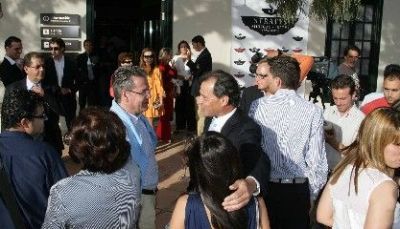
On the one hand, getting them to approve "gross administrative acts in their illegality." On the other hand, by the "impunity" he has enjoyed afterwards, despite the fact that what has been built is nothing like what had been (also illegally) authorized. In addition, he emphasizes that the same public officials who authorized the opening of Stratvs have not only "allowed with impunity the exploitation of the clandestine industry for years", but that they even "allowed themselves to be photographed in public events" in the winery, specifically at its inauguration, which was attended by prominent politicians from all administrations.
A Plan "expressly elaborated to legalize Stratvs"
In addition, the popular accusation adds that this "manifestation of delivery and homage" continues to this day and has become "patent throughout the instruction" of this case, "to the point that the approved regulations, and that have been intended to be approved, have been expressly elaborated with the sole purpose of legalizing the Stratvs tourist complex, and conferring through planning a unique and privileged legal position, unduly equating it with the historic wineries of La Geria."
Transparencia Urbanística refers to the Special Plan of La Geria, approved last July by the Government of the Canary Islands, and also to the modification of that Special Plan that the Cabildo intends to carry out. The modification has already been taken to the Plenary up to three times by the president, Pedro San Ginés, but so far he has not managed to approve it due to the minority in which the government group of CC is located.
Meanwhile, the accusation also denounces that "the degree of interference and the unusual belligerence of the public administrations involved (local, insular and regional) with the judicial instruction and its constant questioning of judicial resolutions are at the level of the demonstration of the economic and social power that Mr. Rosa flaunts."
"Such has been the level of aggressiveness," he adds, "that even the State Attorney General's Office has had to intervene publicly, issuing a note of support for the work of Mr. Ignacio Stampa, who has suffered, along with the investigating judge, a campaign of discredit and personal attack, directed and encouraged from the media owned by Mr. Rosa, unprecedented in democracy." In this regard, he stresses that "the pressure received by the investigating judge, Mrs. Silvia Muñoz, by the Public Prosecutor's Office and by the parties appearing, is only comparable to the tenacity, rigor and firmness maintained in the instruction of the case."
"Faithful delivery" of San Ginés, Fabelo and Rafael Martín
In addition to pointing out the politicians and technicians accused in the case, the private prosecution also refers in its writing to some of the people it considers continue to "bow down" to Rosa's interests in each of the three administrations involved. Regarding the Cabildo, he argues that "the faithful and unreserved delivery in the defense of the interests of Mr. Rosa by the president, Mr. Pedro San Ginés, the Minister of the Environment, Mr. Francisco Fabelo, and the island director of Territorial Planning, Mr. Rafael Martín, has been so public and evident that it has caused social alarm in Lanzarote", due to the "insistent capitulation of public representatives to the capacity of influence and the iron control that Mr. Rosa exerts over those who publicly recognize themselves as his subordinates."
Regarding the Government of the Canary Islands, he questions the "spectacle offered by the director of the Agency for the Protection of the Urban and Natural Environment and some of its officials, with the assistance of the legal services of the Government of the Canary Islands", which "have left a clear mark on the instruction, reflecting the attempt of intrusion and interference of the autonomous Government in the scope of action and the independence of the Judiciary".
Finally, with regard to the Yaiza City Council, he argues that "the actions of the political representatives and public officials bring up to date the verses of Víctor Fernández (the salt worker)". Even, the indictment reproduces its content, which begins with: "If I have my sharecropper as Mayor, what I want results in the Mayor's Office. If I have been the one who put the Secretary, what is written is what I have arranged..."
A "comparable cynicism" in the mayors of Yaiza
Regarding the officials and politicians who are accused in the case, the popular accusation adheres almost entirely to the qualification of the Prosecutor's Office, although it asks to bring one more person to the dock (the former Director General of Urban Planning of the Government of the Canary Islands, Juan César Muñoz Sosa) and adds new crimes for the former mayor of Yaiza, José Francisco Reyes, the former secretary, Vicente Bartolomé Fuentes, and the building surveyor of the Technical Office Pablo Carrasco.
As for Reyes, he accuses him of a new crime of prevarication by omission, for not having stopped the works when he became aware that even the license he granted was not being respected, and that it was also illegal. The former mayor even signed a decree ordering the works to be stopped in 2003, but the popular accusation argues that it was a "paper tiger." In fact, not only did the works not stop, but Reyes even granted an extension of the license two years later.
"He signed the suspension decree with full awareness that it was not going to be complied with" and "deliberately obviated taking any decision that would prevent the continuation of the illegal construction or the sanction of what has already been executed", the writing emphasizes.
In addition, he compares the actions of the former mayor with those of the current mayor, who is also accused of two crimes of prevarication, one by action and one by omission. In her case, after being summoned to testify for the first time as an accused in this case, the judge even asked her if she intended to act from that moment on, given that at least since then she was aware of the illegal situation of the Stratvs macrocomplex.
"Mr. Reyes shows signs of enjoying a clearer mind than the one he has shown in court, flaunting a cynicism comparable to that shown by Mrs. Gladys Acuña, when agreeing to close the restaurant and keep the rest of the tourist complex open in 2014", the popular accusation points out in this regard.
The Yaiza Castastro, open on Saturday for Rosa
In addition, he also adds other details to reflect the "submission" that he considers exists towards Rosa. For example, that the Yaiza Cadastre opened its doors on a Saturday "to allow the change of cadastral ownership", and also "without giving a hearing to the previous owner". In that operation carried out in March 2013, when the instruction of the Stratvs case was already advanced, the land on which Stratvs sits was put in Rosa's name, despite the fact that it had other owners. The head of the Cadastre, Blas Noda, is accused of a crime of falsification of a public document for these facts, since he registered the change of ownership "without carrying out the slightest verification".
The writing also refers in particular to the actions of the head of Classified Activities of the Cabildo, Manuel Jesús Spínola, and the manager of the Insular Water Council, José Juan Hernández Duchemín, both accused in the case. About them, he points out that both their reports and their "non-existent inspection work", "despite the knowledge of the contamination and the danger in the activities that were carried out in the tourist complex, relate a capacity of influence of Mr. Rosa on the decisions of the technicians of the Insular Cabildo of a clear evidence".
In short, and in reference to the role of all the administrations involved, the popular accusation concludes that "the administrative process that is followed in the construction, opening, commissioning and subsequent closure of the tourist complex called Stratvs winery, relates not only a haggling with the law taken to exhaustion, but some doses of cynicism and submission to the capacity of influence of Mr. Rosa by those called to defend the general interest and to guarantee compliance with the rules of a State of Law". And all this, sheltering "the craziest hallucination of a businessman, who has tried to equate himself with the historic wineries of La Geria by means of the procedure of accomplished facts".


