
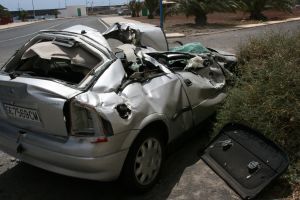
The number of fatalities on the roads where the Civil Guard is responsible for traffic surveillance and safety in the Canary Islands Autonomous Community decreased by 43.8 percent in the first four months of the year, according to reports this Wednesday from the Government Delegate, Salvador García, who also highlighted the decrease of 41.38 percent in fatal accidents.
In an informative event in which he was accompanied by the Deputy Government Delegate in Santa Cruz de Tenerife, José Antonio Batista, and the commanding chief of the Traffic Sector of the Civil Guard in the Canary Islands, Benito Monzón, the delegate emphasized the "significant decrease" in accidents on the Canary Islands roads compared to the same period in 2007, which has meant 14 fewer deaths, while specifying that in both provinces the percentage is identical, that is, 7 people in Santa Cruz de Tenerife and another 7 in Las Palmas. Of these deaths, two were driving motorcycles and another a moped. The three accidents were due to run-offs and all of them were wearing protective helmets.
Regarding the number of fatal accidents, García explained that the percentage is also very similar in both provinces, with a reduction in Santa Cruz de Tenerife of 40 percent and in Las Palmas of 42.90 percent. "In the number of accidents, a considerable reduction is observed and with less harmful results, that is, in most cases the result is material damage," he said.
The delegate reported on the fundamental causes of the decrease in accidents on the Canary Islands roads in recent years, among which he highlighted the increase in alcohol and speed checks, road safety campaigns, the implementation of the driving license by points, the reform of the Penal Code and the increased presence of the Civil Guard Traffic on the roads.
INCREASE IN CONTROLS
Salvador García pointed out that a high percentage of traffic accidents are caused by infractions related to speed in different situations, either due to inadequate speed or exceeding the established speed in the place where the accident occurs, being present in 16 percent of traffic accidents, a percentage that rises to 31 percent when it comes to fatal accidents.
In this line, he indicated that, in order to reduce accidents and their consequences, and in accordance with the calendar established by the General Directorate of Traffic, between April 14 and 27, a speed control campaign was carried out throughout Spain, whose execution in the Canary Islands by the Traffic Group resulted in a total of 129,543 vehicles controlled and 3,099 drivers reported (2 percent).
On the other hand, the Civil Guard Traffic of the Canary Islands has controlled with speed cameras during this quarter a total of 480,238 vehicles, of which 12,838 have been reported for exceeding the maximum permitted speed, which represents 3 percent of the vehicles controlled. The delegate commented that the DGT is installing fixed speed cameras on the roads of the Canary Islands, "which will undoubtedly contribute to improving safety".
Likewise, he reported that the Civil Guard continues to focus on establishing alcohol controls and special operations on weekends and holidays, having carried out during these four months 202,835 alcohol tests, of which 3,392 were positive (2 percent of the people controlled). In this sense, there has been an increase of 10.17 percent in the number of tests carried out compared to last year.
"This increase in the number of alcohol samplings has managed to reduce the percentage of drivers who are affected by the intake of alcoholic beverages, since in 2003, the percentage of drivers who tested positive in this type of sampling was 7.65 percent," he indicated.
ROAD SAFETY CAMPAIGNS
The Government Delegate explained that, within the framework of the calendar of special surveillance campaigns established by the DGT, a campaign is being carried out, between May 12 and 18 on the use of protective helmets by drivers and passengers of mopeds and motorcycles, in order to know the degree of use of this safety element and disseminate the importance of its use.
García emphasized that the use of the protective helmet is a fundamental element to reduce the effects after a traffic accident occurs, "because it has been proven that its use reduces deaths by a third and prevents two out of three brain injuries, without forgetting the use of seat belts and other approved restraint systems, which are of vital importance in significantly reducing, in case of accident, its harmful consequences".
LEGISLATIVE MEASURES
The entry into force of the Driving License by Points Law was another aspect that the delegate highlighted in his appearance, "despite the fact that it presents problems in the immediacy of the sanction, that is, the withdrawal of points from the offender". In this line, he recalled that since December 2, 2007, new limits have been established for driving under the influence of alcoholic beverages and speeding, "and in these months, a significant decrease in accidents on the Canary Islands roads has been observed, largely due to the immediacy of the criminal sanction".
Salvador García specified that during the first four months of 2008, and in application of the reform of the Penal Code, 403 people have been charged with an alleged crime against road safety for exceeding the permitted alcohol level, and another 3 for exceeding the speed limits. In addition, 573 people have been reported for lacking the corresponding administrative authorization, since it has been a crime since May 1. Since that date, he indicated, there has been a decrease in the use of vehicles by people lacking a driving license, since an alleged crime against road safety has been charged to 22 people, of whom 21 had never obtained it and one had it withdrawn by judicial decision.
OTHER ACTIONS
The Government Delegate added that the Civil Guard Traffic has provided during the first four months of 2008 regulation, escort and protection services in sports events, among which he highlighted the Rally of the Canary Islands, valid for the European Rally Championship, and a considerable number of cycling events, marathon or cycling tours, "as all these events affect the main road network of the islands".
Finally, he reported that 25,353 assistance services have been carried out on the roads of the Autonomous Community (humanitarian, mechanical or informative, among others), with a total of 1,509,266 kilometers traveled, of which 753,155 have been carried out in four-wheeled vehicles and 756,111 in motorcycles. He also maintained that the catalog of jobs of the Civil Guard Traffic "is 100 percent covered, being increased with 53 more civil guards in the near future after the increase of the catalog, which translates into a greater presence and effectiveness of the Traffic Sector on the roads of the Canary Islands".
ACN Press
Add La Voz de Lanzarote as a preferred Google source.
Stay informed with the latest current news.


