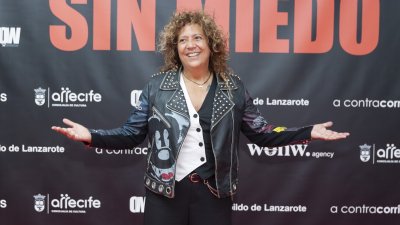
The singer from Lanzarote Rosana Arbelo Gobar (Arrecife, 1963), known in the artistic world as Rosana, visited the facilities of Radio Lanzarote-Onda Cero this week to talk about several artistic projects she is involved in. The musician, one of the most international voices from the island, premiered her docuseries Sin miedo (2026) a few days ago on the platform Prime Video. In addition, she is involved in two projects to recover the connection between people. One of them, Más que barrios, was initiated in Arrecife.
Question (Q). The success of the presentation of your docuseries was impressive, both in Madrid and Lanzarote, but now it has also just premiered on Prime Video, hasn't it?
Answer (A). Yes, then we also went to Mexico, at the International Film Festival, we did it in several places.
And now it has just premiered on Amazon Prime. Yesterday someone wrote to us: "Hey, I'm watching it in Switzerland." "Hey, I'm watching it in Germany." Besides, it is translated into practically all languages [this Tuesday] it was born, and, the truth is that it is working. I hope everything continues to move forward and take this land much further than it already is.
Q. How do you feel when you see yourself as a viewer of your own docuseries?
A. I feel it's very crazy because when you're making it, it's a story, right? When you're filming it, when you're even creating it, it's a story. But when you see yourself, I said it the other day as a joke: "It's the first time I've come to a place to see myself." And it's super heavy because it's true that you become very aware of everything you're telling, and what you're telling is a life truth.
It's a life truth because this documentary is not made to impress, it's made to try to inspire. And in that difference, one undresses and you are left naked. That you share everything you feel because one thing is what has happened with my career, which can be found on Wikipedia, and another thing is what I have felt or the path I have wanted to follow.
Q. The behind-the-scenes of someone as important as you, so famous and successful. How did the idea of making this docuseries come about?
A. Look, the idea came about because seven years ago I received two pieces of news. The first, about the increase in loneliness in human beings. And the second, the brutal increase in suicides in children. When I received these two pieces of news, I became aware that I didn't want to keep making only music, that I wanted to do something more.
Somehow, taking advantage of the fact that my music is known in the world, was a way to open that same world to many other things. To connect, to share, to be aware that life can be gestated and lived in another way. Being aware in parallel that the only thing I like more than music is the human being, then I started writing and decided to put my career, as it is known, aside.
For seven years now, the concept of releasing an album, composing, doing promotion, touring, concerts and so on, I have put it aside to create a project called OMOOU (Another World/Our World).
In parallel to that comes Más que Barrios, a project for revitalizing neighborhoods, which starts in Arrecife. And then comes a tour, which far from being one tour, are three: one associated with the 30 years, another associated with Más que Barrios and another associated with the docuseries.
Q. Now we have seen information like "Rosana makes a surprise appearance in Argana", "Rosana appears with Los Buches", tell me a little more about Más que Barrios
A. This starts in our city, which is called Arrecife, and I couldn't have chosen a better place of birth. [...] It really [consists of] revitalizing neighborhoods, but through connecting, connecting, connecting, connecting different creative energies.
This is also a project that is born for all ages and is born from creativity because we believe that when you talk about art, you mostly talk about music, painting, and sculpture, but when you talk about creativity, you are talking about any profession.
The objective is to return what was lost, I don't know very well where, because it is only hidden, which is community, the tribe, the safe space of the tribe.
Q. It also arrives at a moment I think is very important, because we are all talking about gentrification, about being all inward-looking and we, however, lived in the streets.
A. Totally. Seven years ago, this would surely have been understood as a much more romantic concept. Now I think it is becoming a necessity to give back to the street, to its people. For neighbors to know each other. I always say, lately I say it a lot, when I say returning to the neighborhood it doesn't mean going backwards, it means choosing from the past, what is really essential and one of those things is connection.
Q. How curious that at our age there is a reset there too.
R. I think two things are happening: the first, that it's not a reset, that it's a place I had to reach. And the second, that every day I am more aware that one must die young as late as possible.


Add La Voz de Lanzarote as a preferred Google source.
Stay informed with the latest current news.