
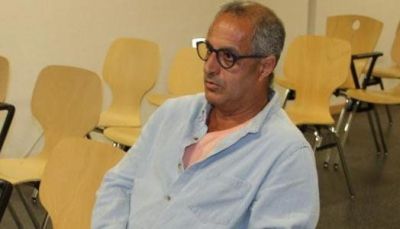
When in doubt, there is no conviction. That principle, known in the legal world as "in dubio pro reo", is what has led Judge Aitziber Oleaga to acquit former City Alternative councilor Domingo García, who was accused of slander, for statements he made in 2013 against the then-advisor to the Arrecife City Council, Cristian Caleri.
In her ruling, notified this Monday, the judge maintains that "it has not been proven" that the former councilor "imputed any crime" to Caleri. "We encounter the obstacle that the documents presented by the plaintiff as evidentiary support for the slanderous phrases against his honor are mere photocopies (private documents) that have been challenged by the defense," the magistrate points out. She refers to the articles published in two digital newspapers on the island, printed copies of which were submitted to the case by Cristian Caleri's lawyer, who filed this complaint.
During the trial, Domingo García questioned those articles and did not acknowledge having uttered the phrases that were recorded in writing. And he did so with phrases like "I am not aware that this is what I said", "I don't know if it was exactly like that", "I don't dare to affirm that this is what I said" and "I cannot assure that this is mine". Therefore, and given that the audio recordings of the interviews, which were conducted on at least two different radio programs, were not submitted in the complaint against Domingo García, the judge concludes that "it is unknown whether what appears in those copies are verbatim words of the accused", so she considers that those documents have no "probative value".
"The tenor of the statements made is ignored"
Although at the time, as he confirmed during the trial, the former councilor did not demand any rectification from those media outlets, he questioned the content and the phrases attributed to him in quotation marks in those articles during the hearing. "The tenor of the statements made in the media and subsequently transcribed in the digital media is ignored due to the absolute lack of documentary and testimonial evidence regarding the content of the alleged slanderous phrases uttered publicly," the ruling insists, which emphasizes that no witness, representative of those media outlets, or author of the articles or interviews was presented either, to corroborate that what was published conformed to what Domingo García declared at the time.
The owner of one of those media outlets, Pedro Martín, did testify as a witness in the trial, although "I don't remember" was one of his most repeated phrases. It was Martín himself who conducted the interviews on the radio and who asked the former councilor about an alleged rumor, about an advisor who had allegedly tried to pass off a bicycle bill to the City Council.
Martín only clarified that he did not give Caleri's name when he asked this question, but he did not remember if it was Domingo García who gave it a few days later, when he interviewed him again. The announcer did not even remember having done a second interview on the radio about this topic, despite the fact that it was also recorded on his media outlet's website.
"If the doubt is not resolved, no relevance can be given to the document"
Thus, the fact that the audio recordings of those interviews were not submitted during the investigation has been decisive in the ruling issued by the head of the Criminal Court Number 3 of Arrecife, who considers the copies of the articles published later in digital newspapers insufficient.
"These documents were not acknowledged by the accused in the act of the oral hearing. He expressed that he could not affirm that what was read in those documents in the plenary session was verbatim what he had said in the radio interviews, given that they were photocopies with paragraphs cut and pasted from who knows where," the judge points out, recalling the statements made by Domingo García as the accused.
"If the doubt is not resolved, no relevance can be given to the document," she concludes, pointing out that since the accusation is based on those copies, "it can only lead to an acquittal, in application of the principle in dubio pro reo". And she insists that "the evidence presented has not been sufficient to understand that the presumption of innocence has been undermined". Therefore, she acquits Domingo García, although she declares the costs of this procedure "ex officio".
"Why don't you run over a politician on a bike?"
In her ruling, the judge recalls that "the only documentary evidence that the accused acknowledged" during the trial was one of his publications on Facebook (he also questioned others). Specifically, the ruling reproduces one of them, published by Domingo García after receiving the complaint from Cristian Caleri and being summoned to a conciliation hearing. "Take that! This one wants to buy another bicycle at my expense. See you in court," he published then. And then, he went further: "You're in your car and you see a politician on a bicycle. Why don't you run him over? Because the bicycle could be yours".
According to the magistrate, "the tone used" by Domingo García in this publication on his Facebook page "is jocular due to the situation created by the judicial summons against him for the crime of slander, but no direct imputation of a crime is appreciated in them". And she insists that for there to be a crime of slander, a specific crime must have been imputed, clearly and expressly, to another person.
Thus, she accepts Domingo García's version and recalls that during the trial, he declared that what he did was "investigate a rumor and talk about it, without stating that Cristian Caleri was the author of any crime since, in any case, what he said was conditional and pending investigation". According to the judge, "a simple twist, the mere use of a conditional in a phrase, serves to debate the alleged imputation of a false crime to the plaintiff". Therefore, by questioning the copies of the articles submitted, and by not having presented the audio recordings, she concludes that it cannot be proven whether that occurred or not.


