
The parish of Arrecife was officially constituted on June 25, 1798, and its first parish priest was Francisco Acosta Espinosa. Before, there was a small hermitage in the area of La Puntilla, next to the Charco that bears the name of the patron saint of Arrecife.
In the archives of the current church of San Ginés Obispo, valuable documents and books are kept about the origin of the mother church of the capital of Lanzarote. This temple, which until the 60s of the last century was the tallest building in Arrecife, has registered extensions throughout its history, treasures unique archives. Among them, the oldest, the Book of Mandates of the Church, which in 2019 commemorates the 350 years of its first annotations.
The parish priest of San Ginés, Miguel Hernández, has made public, and before the media and the Municipal Corporation of Arrecife, this book and its annotations, which reflect those 350 years of history, becoming the oldest existing graphic document on the history of Arrecife, linked to the creation of the church and parish.
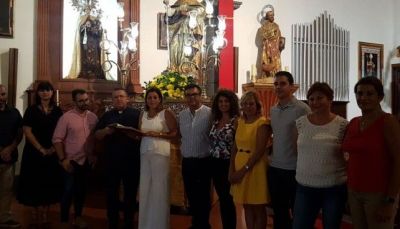
The mayor of Arrecife, Astrid Pérez Batista, made this Friday, August 23, 2019 - on the eve of the celebration of the festival of the Patron Saint of the capital of Lanzarote - an official visit to the church of San Ginés Obispo, patron saint of the municipality.
During the visit, the capital's first mayor was accompanied by all the representatives of all the political forces present in the Municipal Corporation of Arrecife. This 2019 commemorates the 350th anniversary of the first Book of Mandates of the hermitage of San Ginés, which dates from 1669 where it is indicated, on its first page - shown today to the media - that the rebuilding of the hermitage was paid for by Captain Francisco García Sentellas, administrator of the State in Lanzarote.
The historical aspect of this document was revealed and made known by the mayor, the popular Astrid Pérez, in the greeting of the patron saint festivities of San Ginés, which in 2019 have this anniversary as their axis, together with the centenaries of the births of César Manrique and José Ramírez Cerdá.
Until now, the existence of this first historical document of the church of San Ginés was known only through the publications of the different historical research works on the origin of the church of San Ginés Obispo, its invocation, construction, and stages of the different reconstructions and extensions that the church of the patron saint of the capital of Lanzarote has had, dedicated to San Ginés Obispo. The primitive hermitage was next to the Charco de San Ginés, and near the tide, in the area of La Puntilla.
Don Miguel Hernández highlighted before the authorities of Arrecife that among the curiosities of this manuscript of mandates is attached, between its pages, a letter with the handwriting of Pope Benedict XIV - the Pope No. 247 of the Catholic Church between the years 1740 and 1758 (This letter is dated July 1756, a year where drought and calamity ravaged the population of Lanzarote, which had already experienced the volcanic eruptions of the years 1730 and 1736. Later, on that date, the construction of the so-called Fortaleza del Hambre would begin, the current Castillo de San José, built between 1776 and 1779 by King Carlos III to generate labor activity and allow a day's wage to the population of the time.
The parish priest of San Ginés thanked the institutional visit of the mayor of Arrecife and the councilor spokespersons of the different political forces, and announced that this book will be presented to the parishioners and community this coming Sunday, August 25, at 11 am, in the solemn religious function for the festival of the Patron Saint of Arrecife.
Curiously, the origin of the church arrives in Lanzarote and the Canary Islands with the bull of Pope Benedict XIII, July 7, 1404, where the castle, city and bishopric of San Marcial del Rubicón (current beaches of Papagayo) is founded, called Diocese Canariense and Rubicense.
The only two saints of French origin existing in Lanzarote are San Marcial del Rubicón, patron saint of Lanzarote, and San Ginés Obispo, patron saint of the capital of Lanzarote since the second half of the last century XIX.
San Marcial del Rubicón was created in the stage of Pope Benedict XIII. The Book of Mandates of San Ginés Obispo, the first historical document in Arrecife, has among its contents a letter from the other Pope Benedict XIV, dated in the year 1756 addressed to the church of the current capital of Lanzarote


