
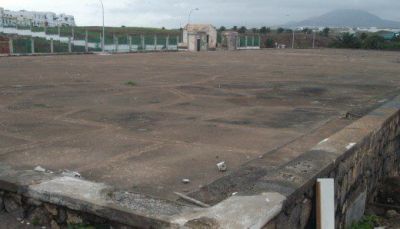
Somos Lanzarote will present a motion to the next plenary session of the Cabildo so that the institution "not only resumes conservation work, but also defines a public use project" for the Maretas del Estado located in Arrecife. They advocate for a project that "responds to some of the needs of the city and its neighborhoods, generating a necessary space for social and cultural development in the outskirts." They propose that the "starting point" of this intervention be the project that the artist Juan Gopar promoted in 1997. The motion includes that in the short term guided tours be carried out and that, in the near future, the place becomes a "reference space for social gathering, culture, training and creation" of the residents, especially from Argana, Titerroy and San Francisco Javier.
The Somos motion regrets that the Maretas del Estado, "testimony of the struggle of the island's people to overcome thirst, have remained abandoned for half a century." They explain that the Maretas Project with Gopar's idea, which AMP Arquitectos drafted in 2002 at the request of the Cabildo, sought to "create a space dedicated to culture and the Environment." Somos proposes that, with that "interesting" starting point, the island institution "address the recovery and enhancement of a piece that not only has undoubted historical and heritage value, but also social, civic and urban value, which should be perceived as the opportunity to structure spatially, culturally and socially a good part of the city of Arrecife."
"If a project for the Maretas was perceived as necessary in Lanzarote in 1997, it should be even more so in 2016. Since then, the island's population has gone from 85,000 to 143,000 inhabitants, and its capital, Arrecife, has increased its census by 25%," recalls the spokesperson for Somos Lanzarote in the Cabildo, Tomás López. And Somos emphasizes that it is precisely the neighborhoods surrounding the Maretas, such as San Francisco Javier, Argana or Titerroy, "which have welcomed a greater number of new residents, who deserve and demand a social, cultural and community life offer," he concludes.
On the other hand, although Somos Lanzarote recognizes that in "these almost 20 years some ideas about the city and the island have been modified (such as the future location of the Biosphere Reserve, which will be in the Marina de Arrecife, or the university campus, in Tahíche), Lanzarote still lacks a space to recognize its ecological history (environmental as well as economic and social), with the culture of water as its axis, while our neighborhoods need more than ever spaces for leisure, culture, creation, reading and meeting, in addition to the undoubted tourist attraction that this space would have."
Guided tours and dissemination in the short term
For the island's assembly organization, it is necessary to take "immediate" measures for "conservation and dissemination", while at the same time resuming, "in the medium term", the idea of giving a public use to the Maretas, seeking funding through funds such as those of the IGTE.
Regarding short-term actions, Somos Lanzarote proposes in its motion the "rehabilitation of the most degraded areas of the Maretas del Estado, including its alcogida, as well as proceeding to open this heritage asset for guided tours and launching a dissemination project on the traditional culture of water in Lanzarote and the Maretas." To this end, the formation proposes to "involve" residents, especially from the closest neighborhoods and their educational centers, "in order to publicize the value of this asset and emphasize the need for its conservation." In this sense, the organization recognizes the work of Don León Tejera in caring for the environment of Las Maretas.
On the other hand, Somos also advocates for "not prolonging the debate on the future use of the Maretas, both in the Cabildo's bodies and through dialogue with other institutions, residents and socio-cultural entities." They consider that this would be the "ideal" space to address the theme of water culture on the island, its link with island ecosystems and with the social, economic and cultural history of Lanzarote, as well as to provide the neighborhoods closest to the Maretas, such as Argana, San Francisco Javier and Titerroy, with a reference space for social gathering, culture, training and creation," they explain.
Otherwise, they believe from Somos Lanzarote, "the situation of abandonment will be prolonged and will feed back, since the protection of the asset must be accompanied by a use according to our time, and without this its conservation would not be effective."


