
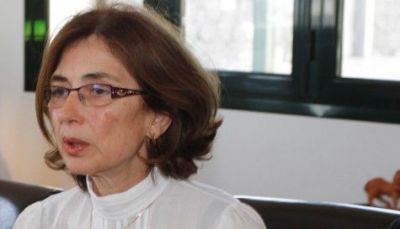
The Government Delegate in the Canary Islands, Dominica Fernández, presented the president of the José Saramago Foundation, Pilar del Río, with the Government's distinction for her defense of women's rights this Tuesday morning. Last November 25, coinciding with the International Day for the Elimination of Violence against Women, the Government decided to award seven recognitions (one per island), and this morning the award ceremony was held in the Library of that Foundation in Tías (Lanzarote).
During the event, Fernández presented Pilar del Río with a sculpture of a menina and pointed out that Del Río is a "symbol for many women who suffer and for men and women to have the same opportunities to get ahead." She said that the Government decided to grant this recognition "to people or institutions that have distinguished themselves for their commitment against gender violence and for those who have not only not looked the other way but have dedicated their time and effort to the fight against violence."
The Government Delegate said that eliminating gender violence is a task for society as a whole and that Pilar del Río has been characterized by her work, commitment and solidarity and for continuing Saramago's path, who wanted to place this problem as a problem outside the private sphere. She recalled that this year in Spain there have been 57 fatal victims, of which three lived in the Canary Islands, and pointed out Saramago's idea that it should be men who take to the streets to denounce these deaths "because the problem is men's."
For her part, Pilar del Río said that "it is an honor that I receive knowing that the one who receives it is José Saramago." She pointed out that Saramago acknowledged in an interview that his father exercised psychological violence against his mother and assured that the writer met very strong women throughout his life who made the characters in his strongest novels female.
She asked that men who are not complicit in mistreatment say so and make it public that they are ashamed of the men who exercise this violence. She wondered what would happen in Spain if ETA had murdered 57 people this year and if there are deaths of first and second class. She pointed out that, because of the suffering they carry, "for many abused women, the best thing that can happen to them is to die" and said that society is sick if it considers one of these deaths a private matter.
ACN Press


