
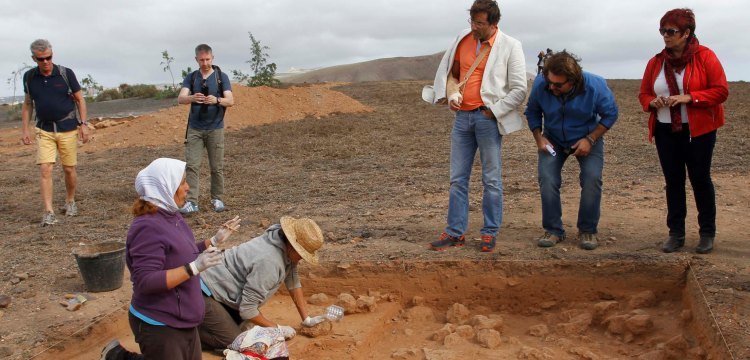
The Cabildo of Lanzarote has resumed the excavation and research work of the archaeological site of Zonzamas. The new works come 20 years after the two Canarian universities, the University of La Laguna and the University of Las Palmas, carried out the latest research and dissemination of the values of this settlement located in the municipality of Teguise. The Island Government commissioned the archaeology and heritage company Tibicena to carry out these new research works, in what the Cabildo has described as a "decisive commitment" by the first institution and its president, Pedro San Ginés, to "enhance and recover the island's heritage". In these new excavations, various archaeological remains have been found, including the skeletons of two babies.
Since the work began, which concludes next week, some 11 soundings have been carried out in the area, according to the Cabildo. In all of them, archaeological remains of "exceptional value and state of conservation, such as fragments of ceramics, carvings, shells and several rectangular structures that could be dwellings of the ancient aboriginal village" have been found.
Babies who may have died in childbirth
Regarding the skeletons of the two "perinatals", according to the experts in this type of studies in bones and infant archaeological remains who are working on this research campaign, "remains of the skull and vertebrae of two children have been found, who may well have been stillborn or who died during childbirth or in the days close to it".
In the same archaeological structure, many remains of "baifos" have also appeared, although their connection with possible funerary practices as well as any hypothesis about these children is unknown, until the mandatory forensic studies are carried out. These investigations and tests, they announced, "would be carried out for the first time in specialized laboratories in the Canary Islands".
For the moment, there are only the first assessments of the archaeologists, who are the reports and relevant studies will help to corroborate or expand.
The architect and co-director of Tibicena, Marco Moreno, explained that the protected area in which the site is located reaches 10 hectares and that in the current research work some 120 square meters have been opened, and may reach 150 in the coming days.
"Definitive, qualitative and quantitative" boost to the site
All these data have been presented this Thursday by the Cabildo, after its president, Pedro San Ginés, and the Minister of Heritage, Carmen Rosa Márquez, visited the area. "It is the hour of Zonzamas", said the president, who conveyed his public commitment to give a "definitive, qualitative and quantitative important boost" to what has been described as the "archaeological site with the most future in the Canary Islands".
Regarding the extension of the site and the richness of what is hidden under the picón and the jable, "it is undoubtedly one of the two most important sites in the archipelago", said Marco Moreno Benítez. The last investigations were carried out two decades ago, so the current excavations and investigations represent the "rediscovery of Zonzamas, to rescue the memory and history of Lanzarote, through this space". It should be remembered that in this settlement a heritage wealth "of incalculable value" has been found, which goes from the 5th century, with remains of the ancient aboriginal village, to the 19th century with subsequent settlements.
During this present legislature, the Cabildo intends to rescue "the living history of Lanzarote that is hidden under our feet", in this site that houses, "at least and being prudent, according to the latest findings, three times more archaeological and heritage wealth than we knew", stressed San Ginés.
The Minister of Historical Heritage, Carmen Rosa Márquez, who accompanied the president of the Cabildo during his visit to this Site of Cultural Interest (BIC), together with the Councilor for Heritage of Teguise, Olivia Duque, also expressed her commitment and the commission made by the president himself to "continue with the investigations and upcoming excavation campaigns".
"Direct connection" with the Archaeological Museum
At the same time, Pedro San Ginés also announced that "the first Island Corporation will allocate in the next budget year a specific item for the execution of a project to put into service and enhance this site, with the rediscovery of the unfinished works that were done in their day with some exhibition space, as a place of cultural, scientific and tourist interest, in which the Historical Heritage Service will begin to work in parallel with the aforementioned investigations".
The Cabildo has announced in this regard that this project will in turn have a direct connection with the Archaeological Museum of Arrecife, which has not yet been opened. Currently, conservation and restoration work is being carried out on the building on Fajardo Street that will house it and the development of the museum project is also being carried out.


