
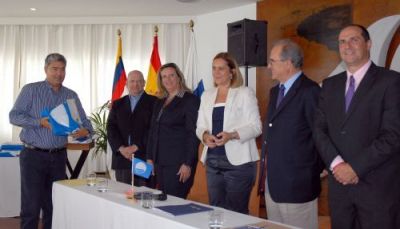
The Minister of Health of the Government of the Canary Islands, Mercedes Roldós, presented this Friday in Lanzarote the 37 awards obtained by the Autonomous Community of the Canary Islands in the 2010 edition of the Blue Flag Program, of which 34 correspond to beaches -two more than in the 2009 edition- and the remaining three to ports.
Puerto Calero, which has been awarded the blue flag for almost 15 consecutive years, was the recreational facility chosen to celebrate this awards ceremony, which also included the general director of Public Health of the Ministry of Health, Enrique Torres, the representative in the Canary Islands of the Association of Environmental Education and Consumer (ADEAC), Eladio Díaz, the entity that awards this award in Spain, and the representative of Puerto Calero, José Calero Rodríguez.
At the ceremony, Mercedes Roldós congratulated the winners, city councils and managers of sports ports, for meeting the high demands of the Blue Flag, which guarantees environmental quality, care of the environment, accessibility and services and a model level of water quality. She explained that the Blue Flag is a selective eco-label granted by the FEE, which in the Canary Islands is managed by the Ministry of Health of the Government of the Canary Islands through the General Directorate of Public Health of the Canary Islands Health Service.
Blue Flag is not only a recognition granted to a beach in a municipality, said the Minister of Health, but to the effort of all and should serve as an incentive to design, define and implement the new model of sun and beach tourism that we want, as well as a concept of sustainable global quality, whose main attributes are, above efficiency or competitiveness: legality, accessibility, global sustainability, healthiness, informed participation, and progressive equity, promoting the concept of network cooperation.
In total, the international Blue Flag jury has awarded 3,511 Blue Flags this year: 2,884 for beaches and 627 for ports in the northern hemisphere. The Jury includes, together with the European Federation for Environmental Education (FEE), the United Nations Agencies for the Environment (UNEP) and for Tourism (UNWTO) and other entities such as IUCN, the EUCC or ICOMIA.
Blue Flag in the Canary Islands: Beaches
Gran Canaria: 8 BA awards
Las Palmas de Gran Canaria: La Laja
Telde: Melenara
San Bartolomé de Tirajana: El Inglés, San Agustín, Maspalomas, Meloneras
Mogán: Amadores, Mogán
Lanzarote: 5 BA awards
Tías: Matagorda, Los Pocillos, Grande (Blanca), Pila la Barrilla
Yaiza: Playa Blanca
Fuerteventura: 7 BA awards
Tuineje: Gran Tarajal
Pájara: Costa Calma, El Matorral, Butihondo
La Oliva: Grandes Playas, La Concha
Puerto del Rosario: Blanca
Tenerife: 10 BA awards
Granadilla de Abona: El Médano, Leocadio Machado, La Tejita
Arona: Las Vistas, El Camisón
Adeje: Troya I-II (Américas I-II)
Santiago del Teide: La Arena
Los Realejos: El Socorro
Puerto de la Cruz: Complejo Playa Jardín
Tacoronte: La Arena (Mesa del Mar)
La Palma: 4 BA awards
Breña Alta: Bajamar
Breña Baja: Los Cancajos
Los Llanos de Aridane: Puerto Naos, Charco Verde
Blue Flag in the Canary Islands: Ports
Gran Canaria: 2 BA awards
PD Puerto de Mogán
Club de Yates Pasito Blanco- San Bartolomé de Tirajana
Lanzarote: 1 BA award
PD Puerto Calero ? Yaiza
Blue Flag in the Canary Islands: Thematic Distinctions
Municipality of Arona, on the island of Tenerife: Information and Environmental Education.
To obtain these distinctions, it is necessary that one of the beaches of the municipality has a Blue Flag in the current year, including the most significant one, as well as that the municipality has applied for said distinction, attaching a separate dossier of merits to its Blue Flag candidacy.
Blue Flag in the Canary Islands: Blue Flag Centers
Municipality of San Bartolomé de Tirajana, on the island of Gran Canaria: Interpretation Center of the Natural Reserve of the Dunes of Maspalomas.
Municipality of Pájara, on the island of Fuerteventura: Nature Classroom of Pájara.
The requirement to become a Blue Flag Center, in a municipality with Blue Flag beaches or ports, is the existence of a visitor center, sea or nature classroom, etc., which includes among its objectives and activities environmental education on coastal ecosystems and/or sustainable development, as well as specific information and/or activities related to the Blue Flag Campaign. The municipality that wants to apply for this distinction must present a supporting dossier of its proposal, as well as, the following year, the annual activity report, together with its Blue Flag candidacy, which justifies the maintenance of its Blue Flag Center status in successive years.
ACN


