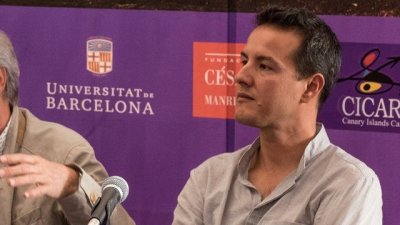
"Lanzarote was not the dry island without underground water resources that the books about water narrate and today we are here to announce the discovery of the Timanfaya aquifer." This is how the spokesman for Podemos in the Cabildo of Lanzarote, Carlos Meca, revealed this Thursday the discovery of a "giant mareta" (water reservoir) that could end the need to desalinate water on the island and, therefore, also end the dependence on oil, as well as lower the price of this basic commodity. Now, he says that "extracting the water will depend on whether there is political will to do so."
For the moment, Meca has already announced that they will present a motion in the Plenary of the Cabildo, to urge the Government of the Canary Islands to carry out the last study that remains pending, to determine the quantity and quality of the water that is hidden under the badlands of Timanfaya. However, the reports collected so far by the party indicate that "in the worst-case scenario", the volume of underground water "ranges between 12 and 17 hm³ of water, which represents between 50 and 70% of the water produced at present", which is 24 hm³ per year. "As the title of the book by the Argentine humorist Roberto Fontanarrosa said, ‘The World has lived wrong’, and in this case this island has lived wrong", pointed out the also secretary general of the party on the island.
In the presentation of this discovery, in which the Podemos group in the Cabildo has been working for almost two years, Meca began by referring to the date chosen to make it public. "We appear on May 25, which is a date that brings back good memories. We considered this day since it has been two years since we were elected councilors of the Cabildo and we thought that the best way to celebrate it was with a gift to the island of Lanzarote and its citizens", he explained. In addition, he referred to the fact that the same date marked the entry of "a transforming political party into the island's institutions, such as Alternativa Ciudadana"; the one that took Podemos to the European Parliament in its first electoral appointment; and also the date on which the Unión case broke out, which opened "a slow but continuous process of democratic cleansing in Lanzarote".
"It can mark a before and after in the history of Lanzarote"
"But today we are not here to talk about corruption or legal complaints", Meca clarified. "Luckily, this May 25, 2017, what brings us here, to our first press conference, is to make public a discovery that can mark a before and after in the history of Lanzarote." Something that "can mean a radical change in the conception of hydrology, the economy and the environment on the island and that, for the moment, will mean that each and every one of the books on water and water culture that have been published about the island will have to be reviewed, not to mention, logically, the Island Hydrological Plan." But for this, after the press conference, he emphasized that it will be necessary for the institutions to stop "turning their backs" on a reality that the engineer Carlos Soler had been warning about for more than two decades.
Carlos Meca had special words of gratitude for Soler. "We want to thank him from the bottom of our hearts for his professionalism, his courage, his honesty and the strength and drive he has shown to demonstrate after so many years that his theory was correct." And it is that, as they have stated during the press conference, Soler had been "trying to convince his superiors" in the Government of the Canary Islands, where he has been holding the position of head of Project Planning of the Water Directorate, "of the opportunity to carry out some simple tests on the island to confirm his theory of the existence of aquifers under the badlands of Lanzarote and with quantities large enough to guarantee the profitability of their exploitation."
However, as Soler explained, "no one" paid attention to him during this time, until the Podemos group in the Cabildo asked him for a report, after contacting him in the autumn of 2015, as soon as they premiered as councilors of the Corporation, to have his advice for the new island Hydrological Plan. It was there when they learned about the thesis he held about the underground waters of Lanzarote. "So, given the way he was ignored by the Government of the Canary Islands and given the magnitude of his theory, we set to work to try to confirm it", Meca related.
"Two entities showed the same enthusiasm as us"
After commissioning a first report from Soler himself, which was paid for with funds from the Podemos group in the Cabildo, the engineer detailed the need to carry out a more expensive geophysical study, which was commissioned to the University of Barcelona. "On this occasion, the study was financed by two entities on the island to which we presented the project and they showed the same enthusiasm for it as us. These two entities are the César Manrique Foundation and the CICAR Group, to whom we want to thank very especially for deciding to pay for the technical studies that have made it possible for us to be here today. From the results of that geophysics study, it can be concluded that Carlos Soler's hypothesis was correct. Or, in other words, and this is the great news: that the Timanfaya badlands function as a gigantic mareta of 200 square kilometers of surface area for collecting rainwater", Meca pointed out.
"We can affirm that we are facing one of the most exciting projects for the future of the island that opens a radically new scenario in terms of energy and island sustainability, which can revolutionize the island's agricultural sector, so in need of good quality water and that, in short, can allow us to finally have water resources without depending on oil", stressed the councilor, who considers that "we are facing the most important event since the sixties and the arrival of the first desalination plants on the island". And it is that, like the engineer who has coordinated and presented these studies, Meca has defended that "this discovery responds to what was the dream that this island always pursued: to achieve a natural, renewable and non-polluting source of drinking water".
"Who was going to tell us that the largest hydraulic work in Lanzarote was not the gigantic and sadly disappeared Mareta de La Villa, nor the Mala dam, nor the Famara galleries, nor the Maretas del Estado, but the badlands that shaped our volcanoes, turning the Timanfaya badlands into a huge natural cistern", the councilor has stated, who has baptized this announcement as "the second water revolution".
"A tribute to the people of Lanzarote who fought against the scarcity of water"
The first "water revolution", in Meca's words, was the one that occurred fifty years ago, "when another brave and audacious engineer like Manuel Díaz Rijo put his effort into demonstrating that desalination was the way out of the drought and poverty that the island had suffered for centuries." Although that, he added, "without prejudice to the fact that before the island was already an inexhaustible quarry of water engineers, as was each of the peasants of this island who built and maintained with enormous sacrifice cisterns, maretas, alcogidas, wells, galleries, gavias, nateros and an endless number of words that until very recently were synonymous with survival on this island".
Precisely to all of them the party wanted to dedicate this announcement, after almost two years of work. "We would like this project, this discovery, to also constitute a memory and a tribute to those who preceded us. To those thousands of men and women from Lanzarote who fought a life or death battle against the scarcity of water. We have before us the possibility of honoring those ancestors who suffered the consequences of the lean years, all the women of this land who walked kilometers to look for water at the nearest mareta, for the men who worked hard building and cleaning cisterns, alcogidas and maretas to survive on the island they believed was dry. To all of them, this finding is dedicated", Meca highlighted.
Among the "direct consequences" that this "giant mareta" under the badlands of Timanfaya can have, the councilor has named five: "end the extreme dependence on oil", "lower the cost of water for citizens", "reduce CO2 pollution on the island", "alleviate the environmental problem" generated by the brines from desalination and "achieve sufficient and quality water for agriculture, without having to resort to treated water" that "is doing so much damage to our lands and certain crops".
Add La Voz de Lanzarote as a preferred Google source.
Stay informed with the latest current news.