
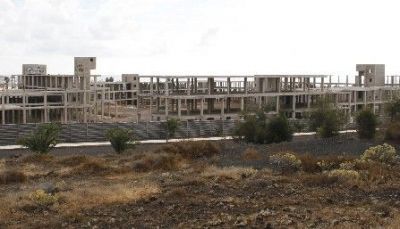
The Udef investigation in the Yate case did not find payments or economic movements that evidenced the collection of illegal commissions by the former mayor of Teguise, Juan Pedro Hernández, so he will only have to answer for an alleged continued crime of urban prevarication. However, in another case, the Unión case, documentation was found on payments linked to the "management" of at least one of the illegal licenses that will make Hernández sit on the bench. And these are "official" payments, covered in "legality" and even with a signed contract.
The one who received that money was one of Dimas Martín's companies, Gestión y Desarrollo Gaida S.L., which charged for carrying out "management" to obtain licenses in Costa Teguise. And all this in a period in which the PIL governed in the municipality under the Mayoralty of Juan Pedro Hernández, who at that time belonged to Dimas' closest circle.
Only between 2001 and 2003, Dimas' company billed at least half a million euros for those license "management" services, and most of the payments were made by the Andalusian businessman José María Rosell, owner of the Grupo Hoteles Playa and beneficiary of one of the licenses for which Juan Pedro Hernández is charged in the Yate case, which has already entered the final stretch to go to trial.
"As many procedures as necessary"
Rosell signed a contract on February 22, 2001 with Dimas' company, in which it committed to carry out as many procedures as necessary before the corresponding organizations, especially the Lanzarote Planning Office, dependent on the Island Council, the Territorial Policy and Tourism Councils of the Government of the Canary Islands and the Teguise City Council, until obtaining the construction licenses" in two plots of his property.
That same day, Rosell delivered two promissory notes for an amount of 270,455 euros, which were deposited in the account of Dimas Martín's company. Nine months later, Juan Pedro Hernández granted Rosell the permits he requested for one of those plots, the 216. And he did so without a legal or technical report from the City Council and without even requesting the compatibility report from the Island Council.
The license (extension of a previous one granted also illegally in 1999) was later annulled by the Courts and is now one of those that will take the former mayor to trial for prevarication.
Payments to Fernández Camero for advice
What Juan Pedro Hernández did have when he granted the extension of that license, according to the UCO, was a report that the lawyer Felipe Fernández Camero had prepared for Rosell's company. In the Unión case, the agents even found the invoice for the preparation of that opinion "on the validity of the license granted by the Teguise City Council to build a five-star hotel on plot 216 of the Costa Teguise urbanization." A validity that did not really exist, as determined later by the Courts.
The invoice for Camero's "legal services" was paid directly by Dimas' company. In total, through the company Adelfas 24 S.L., the lawyer received two promissory notes: one for 2,126 euros and the other for 1,890 euros, corresponding to the fees for preparing the report on plot 216 and another on 232, also owned by Rosell.
In the contract signed with José María Rosell, it was established that the 270,455 euros that Dimas' company received would be used for "the expenses that occur as payment to the different organizations for rights or fees for obtaining licenses", with the PIL leader keeping "fees of 10 percent of the final settlement that results." However, the only "expense" that the UCO located linked to those alleged management of Dimas' company were the payments to Camero.
In the Yate case, Felipe Fernández Camero was charged as the alleged "mastermind" of the scheme of granting illegal licenses both in Costa Teguise and, especially, in Playa Blanca. The Prosecutor's Office even pointed him out as the instigator of the allegedly criminal conduct of the former mayor of Yaiza, José Francisco Reyes, although that charge was eventually dismissed for lack of evidence to prove his advice.
However, he remains charged in a separate piece of Yate for embezzlement, precisely for the money he received from the southern City Council without any work to justify the payments. In addition, he is also charged in the Unión case for his time as secretary of the Arrecife City Council.
Other "intermediations" of Dimas
Apart from the 270,000 euros that Dimas' company charged for the management related to two plots of Rosell, the PIL leader also received other payments of hundreds of thousands of euros from the same businessman for similar management in other of his properties. In addition, Dimas' company signed contracts with other companies. One of them, with Urincasa S.A., which intended to obtain an extension of the license to build 372 apartments in Costa Teguise.
In the contract, Urincasa committed to deliver an initial 180,304 euros and another 300,506 euros "upon presentation of the invoice for the definitive renewal of the license correctly legalized." On March 1, 2003, the 180,304 euros were deposited in the account of Gestión y Desarrollo Gaida S.L., although there is no record of the other payment.
In the documentation that is part of the summary of the "Unión" case, there is at least one similar operation with another company in Arrecife, where at that time the PIL also governed, under the Mayoralty of María Isabel Déniz. In that case, a commission of almost 50,000 euros was agreed in writing for mediating in the sale of a clinic, located on a plot that, according to the UCO, was intended to change its use in the General Plan.


