
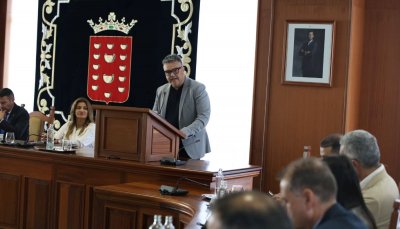
During his speech, Santana recalled that the population of Lanzarote has reached 163,230 inhabitants, the largest percentage increase of all the Canary Islands in 2024. He also added that almost one in four residents is foreign, a reflection of a continuous migratory phenomenon that fuels this growth.
The councilor detailed that demographic projections point to a particularly complex scenario: 2033: more than 186,000 inhabitants, 2039: nearly 200,000 inhabitants, and 2045: more than 207,000 inhabitants"We are facing growth that could add more than 40,000 inhabitants in less than twenty years. No island of our size can assume such an increase without planning, investment, and political consensus," he stated
Santana pointed out that this growth is already behind some of the island's main current problems: the lack of affordable housing, pressure on roads, increased energy consumption, greater demand for desalinated water, saturation of public services, and the progressive deterioration of the territory and ecosystems.
A plan to guarantee economic and social sustainability
The counselor recalled in his speech that the Plan for the Activation to Stimulate Sustainable Economic and Social Growth already exists, a document agreed upon with all political groups and with the island's economic and social agents. Within this framework, he highlighted the Master Plan for the Finalist Tourist Economic Contribution, which he defined as "the most decisive financial tool for the future of Lanzarote." As he explained, this mechanism could generate more than 82 million euros annually, the equivalent of 40% of the Cabildo's current budget, entirely dedicated to sustainability projects. These resources would allow for key investments in: water and purification infrastructure, sustainable mobility and emissions reduction, public and affordable housing, energy transition and renewable energies, coastal and biodiversity protection, as well as innovation and economic diversification


