
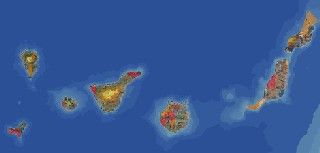
Currently, 80 percent of them have this protection seal. During 2009, the autonomous department led by Domingo Berriel will maintain the momentum of the planning instruments with the aim that in 2010 the formulation of the Plans for the Protected Natural Spaces will be completely finalized.
"To make the protection of natural values compatible with the rights and traditional uses of the local population" is the objective of these rules, said the Minister of the Environment and Territorial Planning, Domingo Berriel, who highlighted the need to continue promoting the conservation, reconstruction and restoration of the Natural Spaces of the Archipelago, in a process that favors a greater social sensitivity, understanding that restoring nature and recovering territories for the public domain of the environment is a process to exemplify a way of doing public action, in a project that must be socially shared, both for protection and for the sustainable management of resources".
Of the total of 146 Protected Natural Spaces spread throughout the Canary Islands, which represent the main heritage of the Canary Islands and a tourist attraction to be safeguarded, 111 have definitive conservation regulations. The plans and rules of the rest are in the phase of progress, initial approval or in the period of adaptation to the Revised Text of the Laws of Territorial Planning and Protected Spaces of the Canary Islands and the Law of Guidelines.
By islands
Gran Canaria is the second island with the highest number of protected spaces. Of the 33 it has, 24 have final rules; followed by La Palma, with 20 spaces and 16 with plans approved definitively; and La Gomera, with 17 (12 have conclusive rules). For its part, Fuerteventura has 13 and only one, the Betancuria Rural Park, is pending the approval of its management and use master plan; Lanzarote has 13 areas and three still do not have the text definitively approved, while all the spaces of El Hierro (7) have final plans.
Tenerife is the one that brings together, with 43 natural areas, the largest number of these protected spaces. Of these, 30 have definitive conservation accreditation and six are subject to the analysis of the allegations presented during the public exhibition of the final document, a prior step for its definitive approval. These last natural areas are La Corona Forestal, Barranco de Fasnia and Güímar, La Montaña Colorada, Roque de Jama, La Caldera del Rey and Roque de Garachico.
The zones that make up the Canary Islands Network of Protected Spaces are subject to eight different categories of protection, which are the National, Natural and Rural Parks, the Integral and Special Natural Reserves, the Natural Monuments, the Protected Landscapes and the Sites of Scientific Interest.
The National Parks (Garajonay, Caldera de Taburiente, Timanfaya and El Teide) and Natural Parks (Canarias has eleven of these spaces, of which three are in Ferteventura, one in Tenerife, two in Gran Canaria, two in Lanzarote, one in La Gomera and two in La Palma) are the best preserved areas, where the presence of man is less. In them, public use and the promotion of man's contact with nature is in itself the object of conservation.
Likewise, the twelve spaces defined as Integral Natural Reserve in the Canary Islands (four are in Tenerife, one in Lanzarote, another in La Gomera, two in El Hierro and another two in Gran Canaria and La Palma) are in the most restrictive category, since almost all uses are limited in them, while in the Special Natural Reserves (Tenerife has six, La Gomera and El Hierro with one, respectively, and Gran Canaria with six) scientific, educational and exceptionally traditional uses are allowed. For their part, the Sites of Scientific Interest are specific areas that are protected for the conservation of a specific biological resource.
The Canary Islands Network of Protected Natural Spaces is a regional system in which all the areas that are part of it are declared and managed as a harmonious whole with the common purpose of contributing to human well-being and the maintenance of the biosphere through the conservation of nature and the protection of the aesthetic and cultural values present.
The planning provided for by the Law for each of the protection categories allows recognizing where the greatest conservation efforts will be made. Thus, the parks will have a complex and more developed document, such as the Master Plans for Use and Management. The Natural Reserves will have a Master Plan, which is a more concise planning document, mainly oriented to the conservation of the natural resources that justified the declaration of protected area. The other categories, Protected Landscapes, Natural Monuments and Sites of Scientific Interest, will be regulated by simpler rules: a Special Plan in the first case and Conservation Rules in the other two.
Current situation
If a photograph of the current situation by islands is taken, it can be seen that the Integral and Special Natural Reserves of Tenerife have definitive regulations, as well as the Teno and Anaga Rural Park, eight of its Natural Monuments, five of its Protected Landscapes and all of the Sites of Scientific Interest.
Gran Canaria has definitive regulations in one of its Integral Natural Reserves, in its six Special Natural Reserves, in its two Natural Parks, in one of its Rural Parks, in seven of its Natural Monuments, in four of its Protected Landscapes and in three of its Sites of Scientific Interest.
Lanzarote has plans approved definitively in its Integral Natural Reserve, as well as in one of its Natural Parks, in all its Natural Monuments, in one of its Protected Landscapes and in its two Sites of Scientific Interest. For its part, in Fuerteventura, its three Natural Parks have final conservation plans, as well as its six Natural Monuments, two Protected Landscapes and the only Site of Scientific Interest on the Island, Playa del Matorral.
The spaces of La Palma that have conservation regulations approved definitively are: its two Integral Natural Reserves, its two Natural Parks, six of its Natural Monuments, two of its Protected Landscapes and its three Sites of Scientific Interest. El Hierro, for its part, has the final plans for all its Protected Natural Spaces, while in La Gomera only four areas are pending the processing of their final conservation accreditation.


