
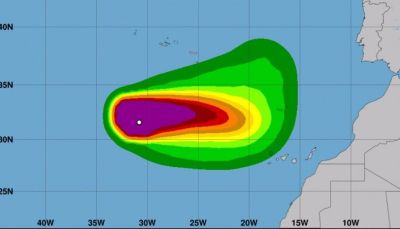
The tropical storm 'Theta', which is currently hundreds of kilometers west of the Canary archipelago, continues with sustained winds of more than 100 kilometers per hour, but in recent hours has modified its trajectory and is now heading further east of the Canary Islands. However, from Friday it will weaken, according to the State Meteorological Agency (AEMET).
The AEMET spokesman, Rubén del Campo, explained in statements to Europa Press, that with this new change of direction 'Theta' will approach the Canary archipelago more but, as during the afternoon of Friday it will begin to turn southeast, this will cause it to weaken although until then the winds will continue with gusts close to 105 kilometers per hour.
In this sense, the spokesman insisted that the oceanic and atmospheric conditions that 'Theta' encounters in its path will not be "the most favorable" to maintain its tropical cyclone condition.
At the same time that the tropical storm weakens, Del Campo has specified that an Atlantic trough will be approaching "little by little", which will push the storm towards the northeast, definitively moving it away from the Canary Islands between Saturday and Sunday, which will be when 'Theta' loses its tropical cyclone condition and becomes an extratropical cyclone with a mid-latitude depression.
However, Del Campo has qualified that during Saturday it could affect the Canary archipelago with a "quite low" possibility. This could happen until Tuesday morning, especially on the island of La Palma, which could have tropical storm winds with sustained speeds for at least one minute of 60 kilometers per hour, not ruling out that they may occasionally reach 90 kilometers per hour.
On the contrary, in the rest of the Canary Islands, Del Campo has stated that there will not be a significant increase in wind, that is, there may be strong gusts but they will not generate a great impact. In addition to all this, Del Campo has added that there will also be an "important" maritime storm, which will be noticeable on the north and west coasts of the islands with greater relief, mainly in the western islands.
Add La Voz de Lanzarote as a preferred Google source.
Stay informed with the latest current news.


