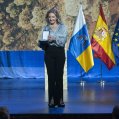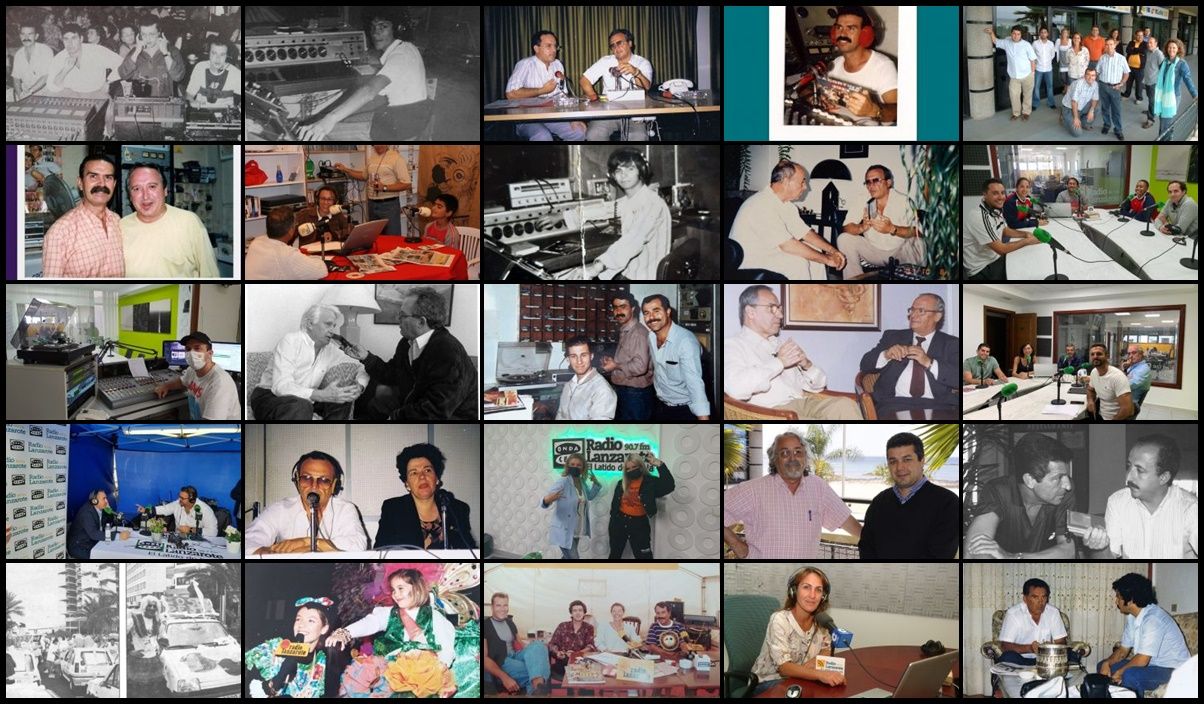
Radio Lanzarote celebrates its 50th anniversary this year, having already shared half a century of history with the people of Lanzarote. It was on December 9, 1972, when the island's leading radio station began its first test broadcasts, and since then it has become an indispensable tool in island society.
“We have managed to ensure that, thanks to Radio Lanzarote, Hindu businesses are selling FM transistors in truly industrial quantities,” published the newspaper El Eco de Canarias, reflecting what the birth of this station meant on the island. It was not only a pioneer in Lanzarote, but also in the Canary Islands, becoming one of the first FM stations in the archipelago. Its signal already reached Fuerteventura, where it was the first and only radio station of the time, becoming a benchmark in the neighboring island as well.
The project arose from the hand of Juan Perdomo, together with Guillermo Montes, and Agustín Acosta joined them as a speaker. Shortly after Perdomo left the project, it was Agustín Acosta who took over the radio, which became a family business, which is still managed by his children today.
“It was a real revolution on the island map”, recalls Techy Acosta, reviewing all the programs that have marked the history of the station, and also that of the island. Some continue to this day, such as “Buenos días Lanzarote”. Others have left an indelible mark on all those who lived through that era, such as “Lanzarote va de ronda”, thanks to one of the unmistakable voices of Radio Lanzarote, that of the announcer Francisco José Navarro.
“That was tremendous. Everyone was waiting to see what the love messages were that were being sent that day, who was giving the round to whom... It was total expectation, it was one of the most mythical programs on the radio on the island. There are still those who perfectly remember that person who for 7 years was dedicating songs to an impossible love. It was incredible,” recalls Techy Acosta.
Like that one, many other programs marked the schedule of a radio that has been much more than a means of communication. It has been a public service, in the broadest sense of the word. For example, when current technological advances were still unimaginable, all Red Cross ambulances had a small transistor in the car, and through the radio they were notified of where there had been an event or an accident that might require their presence. Even the person who lost something, went to the station to look for it.
“Radio Lanzarote's relationship with its people was so close that when someone found keys in the street, a wallet, or whatever, they took them to the radio,” recalls Alberto Acosta, who currently presents the program La Destiladera and in the 90s already did controls at the station. “There was an area where lost items were left. People went to the radio studios to collect their lost belongings before going to the police stations in their municipalities,” he says.
In short, it not only kept its listeners informed of all the news, but was also part of people's lives. And of course, also of its culture.
Quarry of successful singers with the Guatatiboa festival
Radio Lanzarote itself launched the Guatatiboa music festival, which was broadcast from the San Antonio hotel, and where many singers from the island had their first opportunity. Among others, the tenor Pancho Corujo, who today triumphs on international stages, and almost all the great singers and musicians of this island, as well as all the folk groups, performed there.
In addition, Radio Lanzarote began to bring all the galas, contests and events that took place on the island closer to the people of Lanzarote, following them from within. It was a radio on the street that would set up a stand at the Carnival contest to be able to broadcast it, and would go into the rehearsal rooms of all the murgas on the island, to give them a voice from their own headquarters.
“Local television did not exist and we were the only ones who broadcast all the contests, galas, and events. The radio brought all the culture, all the activities, all the festivities to homes”, explains Techy Acosta.
From San Ginés to the pilgrimage of Los Dolores, in which Radio Lanzarote also became a pioneer with its broadcast. It was in 1991, under the presidency of Chana Perera's Cabildo, when this station was for the first time on one of the pilgrims' carts until reaching the Plaza de Mancha Blanca, to follow the entire journey in detail.
The island's political “alarm clock”
Meanwhile, during this half century Radio Lanzarote has also witnessed and notarized the island's political news. Shortly after starting its broadcast, “Buenos días Lanzarote” was born, presented and directed by Agustín Acosta, who from the first hour gave a preview of all the movements in the convulsive island politics.
It was the “alarm clock” of politicians, as many confessed, who heard their phone ring when the sun had not yet risen and knew that they should answer Agustín's live call. There is no politician from Lanzarote who has not been on the program, in which all the presidents of the Government of the Canary Islands of these 50 years have also participated.
In addition, prominent politicians from the national sphere have joined them, including former President Felipe González, who spent some time on the island when he was underground and was known as Isidoro, and gave his first interview on Radio Lanzarote. Tierno Galván, Alfonso Guerra and even Adolfo Suárez were interviewed on the program, in some cases from the halls of the San Antonio hotel. The leading local news program has continued to be broadcast uninterruptedly to the present day.
And of course, Radio Lanzarote has followed all the elections held in these 50 years, providing information from the first hour of the morning until late at night.
The history of Lanzarote has been told live from this station, which has also had to cover tragedies such as that of the Cruz del Mar. That day, the usual programming was interrupted and for more than 12 hours a permanent follow-up was made of the news that was arriving. The whole island held its breath and remained glued to the transistors, shocked by what was happening.
Luxury collaborators and stellar role of Manrique
“One of the keys to the success of Radio Lanzarote has been all the professionals who have passed in front of and behind its microphones, leaving their mark and good work”, highlights Techy Acosta. Together with them, collaborators have played a fundamental role in the history of the station, with personalities as important in its beginnings as Guillermo Topham, Rafael Ángel Domínguez, Leopoldo Cabrera and Agustín de la Hoz.
“The most outstanding people in the world, not only political, but also cultural on the island, collaborated with the station,” emphasizes Acosta, who places César Manrique in an exceptional place. “The first Radio Lanzarote studios, on Avenida Mancomunidad 14, were César's house. He came and went whenever he wanted. He would say 'I want to talk' and he would grab the microphones,” he recalls.
All the demands that Manrique launched through the media began by doing so on Radio Lanzarote. Later, La Voz de Lanzarote also joined, when this newspaper was born within this communication group, but its first media loudspeaker was the radio. There, César Manrique began to talk about revolutionary concepts for the time, such as the commitment to sustainability and quality tourism. When a topic outraged him, he simply burst into the studios and grabbed the microphone.
In addition, the radio also forged ties with journalists as important as José María García, who became a weekly collaborator, as Agustín Acosta himself explained in an interview published in 1999 in La Voz de Lanzarote. A friendship arose between them, which even led to an agreement with Cope, to which Radio Lanzarote was associated for a long time. It is currently linked to Onda Cero, which it joined in 2012 due to the values that both share, prioritizing credibility, plurality, and independence.
There are still nostalgic people for the Frangollo Rally
Of the three missions that should guide journalism - inform, educate and entertain - Radio Lanzarote has not neglected any, and even from its beginnings it also made a banner of the latter. The creation of a music festival was joined by that of the Frangollo Rally, which was maintained for several editions. This rally was a kind of gymkhana throughout the island, in which the participants traveled by car and had to overcome different tests at various points established by the station.
“There are still people who stop us on the street and say: Please, do the Frangollo rally again, that was very fun”, says Techy Acosta.
Another milestone came with the elaborate April Fool's Day pranks that were made, especially in the early 90s, by Agustín Domingo Acosta, who at that time worked on the radio. Even extraterrestrials appeared on the mountain of Santa Bárbara, in jokes that many ended up believing thanks to all the “accomplices” who participated, including the Insular Directorate of the State Administration in Lanzarote, the City Council and the police.
Technological revolution with the same essence
Five decades later, nothing remains of the reels, cartridges, vinyl records and cassettes that marked the first years of broadcasts. Nor of sticking the telephone to the studio microphone so that the sound of an interview could be heard on the air.
“As far as material is concerned, the leap was abysmal. From the Stone Age to the latest in technology”. This is how Francisco José Navarro summarized it, who when he retired in 2017 took stock of his 44 years at a station that he saw grow, and that grew with him.
Today the radio can even be “seen”, with the cameras in the studio and live broadcasts through social networks. But beyond that technological revolution, the essence remains intact. “One issue that has survived during these 50 years is that the radio was born to give a voice to citizens. To denounce injustices, to echo the problems in the neighborhoods, to make their struggles public...”, highlights Techy Acosta, who emphasizes that this role is still alive, in tandem for years with the digital newspaper La Voz de Lanzarote, in a synergy that makes them continue to be the media of reference on the island.
“When the radio was born there was absolutely nothing in the neighborhoods. And through the neighborhood associations and through so many groups that have passed through Radio Lanzarote, force has been made to achieve a better Lanzarote”, recalls Acosta, who insists that “that survives to this day”. “The radio has always been close to the people of Lanzarote, and today our microphones are still open so that people can participate and raise their voices.”

Add La Voz de Lanzarote as a preferred Google source.
Stay informed with the latest current news.