
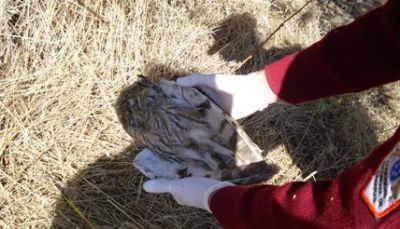
"One of the biggest problems for Spanish fauna." This is how the territorial delegate of the Canary Islands of the environmental organization SEO/Bird Life, Cristina González, expresses herself when talking about poison. A fact about which she assures that there is very little data in the Canary Islands but that, nevertheless, it is "the main threat" to some species, even endangered ones, such as the Egyptian vulture.
The territorial delegate of SEO/Bird Life in the Canary Islands affirms that the use of poison is "a social problem", that "people have taken root". And it is that, according to her, "since 1800-1900, farmers, ranchers and even hunters began to use it to kill certain animals, which ate their crops, livestock or game. Even, González adds, "the governments themselves encouraged its use."
From there, they have been used, depending on the autonomous community, "more for some reasons than for others" and "people see its use as normal". "It has to be changed, they have to be made to see that poison is not a solution, but a problem." And it is that, even today, the use of poisons is a crime typified, even punishable by imprisonment, in the Penal Code and in the Civil Code.
The Canary Islands, according to González, is one of the autonomous communities where there is a "great use of poison", especially, she explains, in the type of "phytosanitary products". "Poisons are being used a lot, in an uncontrolled way and are doing serious damage," says the territorial delegate of the Canary Islands of SEO/Bird Life, who explains that sometimes "it is being placed indiscriminately, in easily accessible areas", and that they have even had "cases of child poisoning in La Palma."
In addition, poison is the main threat to the Egyptian vulture, an endemic subspecies of the Canary Islands, which is in danger of extinction. For this reason, the Government of the Canary Islands and the Ministry of the Environment have launched a campaign, which will be developed by SEO/Bird Life, with the aim of reducing poison from the fields and improving citizen information in the event of possible poisoning.
Within this campaign, the organization has given informative talks this week in Lanzarote and Fuerteventura, to raise awareness among people about this problem. And it is that there are only 42 pairs of Egyptian vultures left in all of the Canary Islands, 38 of them in Fuerteventura, two in Lanzarote, and the other two in the islets.
Since 2000, SEO/Bird Life has been aware that 17 Egyptian vultures have died in the Canary Islands, most of them in Fuerteventura, which is where there is a larger population of this species. However, González points out, poison is also "affecting other species" in the Islands, such as "the owl, the buzzard or eagle, the raven or the common kestrel."
A non-selective method
And it is that, if the territorial delegate of SEO/Bird Life in the Canary Islands insists on something, it is that "poison is not selective." "The farmer places it so that the lizard does not eat the vineyard. He puts the poison, the lizard dies, a kestrel eats it, the kestrel dies, another larger bird of prey comes and eats it... And it's a whole chain," she explains.
In fact, there have already been cases in Lanzarote, in which the hunters themselves have reported multiple cases of animal poisoning, including many hunting dogs. A fact in the face of which the president of the hunters of Lanzarote, Bernabé García, wondered, just a few months ago, why "measures have not been taken in the matter" and demanded "an investigation" in this regard since, according to he stated, they were even "reducing their activity due to the increase in cases of dog poisoning."
And it is that, although Cristina González affirms that the hunters themselves are the ones who use poison in many cases so that other animals do not eat their prey, in the case of Lanzarote, she points out that the hunters are very aware. "Many complaints reach us through them," she says.
A regional fight plan
In the case of the Canary Islands, except for the Egyptian vulture, which is monitored, there is hardly any more data about this problem. Although, adds the territorial delegate in the Canary Islands of SEO/Bird Life, "there is not much data at a general level either." In fact, she says, only "between 3 and 15 cases" are known of animals that die because of poison.
This is something that the organization is trying to remedy with the LIFE Poison project. An initiative, financed by the European Commission, which will be developed over four years. In addition to the Canary Islands, another 13 autonomous communities have joined it. "Only Madrid, the Balearic Islands and La Rioja are missing, but we hope they will join too," says Cristina González.
This project, she explains, aims, among other things, to establish a regional fight plan against poison in each community since, at present, only Castilla La Mancha, Aragón and Andalusia have one, as they concentrate "a larger population of birds and vertebrates and a greater use of poison." "In the rest of the Communities, there has been a clear lack of will," says González. In fact, she points out, the Canary Islands, with the use of poison that there is and the biodiversity that it has, should have had a plan to fight against poison for a long time," she adds.
In the case of the Canary Islands, implementing this fight plan would entail knowing in this sense how it affects the Canary Islands and, from there, knowing what to do, how to do it, and with what methods to fight for poison. And, also, what protocol to follow in cases of poisoning.
But, above all, a dissemination campaign will be carried out to try to show that poison "is not a solution." Although, yes, according to González, they are also aware that solutions must be found to the problems that farmers, ranchers and hunters complain about. Solutions that would involve, for example, carrying out studies that demonstrate that, without the use of poison, it can be achieved that certain animals do not attack crops or, at least, do so to a lesser extent.


