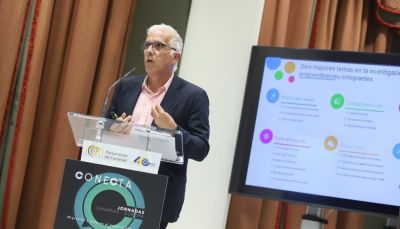
The director of the University Expert in Intelligent and Innovative Business Management and professor at the University School of Tourism of Lanzarote, Pedro Calero, stated this Tuesday that the tourism sector in the Canary Islands "would be nothing without immigrants".
Calero has given a presentation on entrepreneurship and innovation among the immigrant population in the tourism sector of the Canary Islands, within the framework of the conference on Migration and Asylum in the Schengen area organized by the Parliament of the Canary Islands.
And in it, he emphasized the capacity that the migrant population generally has to undertake, focused mainly on the hospitality and restaurant sector, in addition to commerce.
He brought up a piece of data: 32% of restaurant licenses in the Canary Islands are requested by foreigners, "and perhaps the percentage is even higher".
Generally, these people start working as kitchen helpers, as 'dishwashers', while they learn what they need to set up their own business.
"They come to correct many inefficiencies. Without immigrant entrepreneurs, the tourism sector would often not even develop", for example, restaurants in tourist areas: if it weren't for this immigrant entrepreneurial fabric, it would be very complicated", he reflected.
Pedro Calero elaborated that tourism in the Canary Islands is "sustained" by migrant people, and has advocated for promoting and taking advantage of that entrepreneurial capacity due to their training in their countries of origin, but, above all, due to their experience in their migratory journey: they see business opportunities that locals do not see.
The University Expert in Intelligent and Innovative Business Management has carried out a study, which emphasizes the problem of labor shortage in the tourism sector in the islands and the absorption of foreign workers.
At this point, Pedro Calero indicated that a new hotel with 1,400 beds is planned to open in Lanzarote and that it needs 400 workers "to start", and yet "there will not be a local population to take on those positions".
He added that tourist activity offers salaries that for "many" of the migrants are "quite positive" compared to their places of origin, without intending to "hide the precariousness" that exists in the sector.
But the sector also "needs people with the ability to understand the world more broadly than someone local, who has traveled less".
"In general, the sector basically needs immigrants as employees and as entrepreneurs, it needs certain businesses that the local business fabric is not capable of developing", he stated.
The work developed by the University Expert in Intelligent and Innovative Business Management analyzes the reasons why a migrant person decides to undertake, and the first is a matter of "necessity: many have been forced to have their business because they are blocked in the labor market, even with important qualifications in their countries of origin, due to homologation problems".
Then there are those who do it because "they have seen another type of operation of companies in other places, needs covered in other places".
"The personality traits" of the migrant population and entrepreneurs are also analyzed, which "usually coincide quite a bit", since the former "have risked their lives to improve, they leave their country without knowing what they are going to find: they take many risks".
The "social networks" in the strict sense, not the virtual ones, are also "a key element" in the development of entrepreneurship of the immigrant population, because faced with the "problems" they encounter when looking for financing, they end up going to compatriots, especially Chinese and Indians, and they also have access to "loyal and often cheap labor".
These networks are usually concentrated in certain businesses, which at first can be an advantage but in the long run ends up being a disadvantage.
The study has detected two types of businesses: those that copy from compatriots who settled earlier in tourist areas, who are usually older and opt for the "self-exploitation" model; and those that innovate, generally younger people and with "more desire to integrate" into the local culture.
This type of entrepreneur has other competitive advantages, such as maintaining links with their countries of origin, which helps them to weave international networks, but also disadvantages, such as the language barrier, and this is where Italians or Latin Americans have it easier.
As a reflection, Pedro Calero has invited public administrations and other institutions, such as chambers of commerce, to adapt training to immigrant entrepreneurs, and also banks to adapt their financing programs.
He has also alluded to another study by the research group of the University Expert in Intelligent and Innovative Business Management in which it is concluded that the arrival of pateras and cayucos "does not scare" tourists.
On the contrary, "many times" these tourists "do not find out" about the migratory phenomenon and "normalize" that "the majority" of the people who attend to them during their stay on the islands "are immigrants".
"The destination does not lose authenticity because the tourist is attended to or the business is run by immigrants", he concluded
Pedro Calero: Tourism in the Canary Islands "would be nothing without immigrants"
The professor from Lanzarote has given a presentation on entrepreneurship and innovation among the immigrant population in the tourism sector of the Canary Islands, at the conference on Migration and Asylum in the Schengen area organized by the Parliament of the Canary Islands.
September 19 2023 (16:11 WEST)
Updated in
September 19 2023 (16:24 WEST)