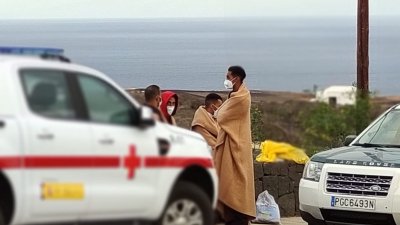
A total of 158 residents of Lanzarote and 25 organizations have signed a manifesto for migrants to "be treated respectfully." According to them, it is "a call to individual and collective responsibility that is addressed to both the population and the media and public institutions", and to which they can adhere through the digital platform change.org.
In this initiative, the signatories express their "concern, as inhabitants of Lanzarote, that people arriving in boats receive dignified treatment and that their rights are not violated during their stay on our island."
Thus, they reject "the intention on the part of some sectors of the population and political representatives to create social alarm based on an alleged relationship between the arrival of boats to Lanzarote and the risk of contagion by Covid-19" and "the openly xenophobic and racist reactions expressed in the media and on social networks, which endanger peaceful coexistence."
"Anyone who travels through our island, migrant or tourist, deserves to be treated with respect and be received with hospitality. The most vulnerable women and men, such as unaccompanied minors or people with health problems, must always be protected," they state in the manifesto.
In it, they point out that "the alleged risk of contagion of Covid-19 by people arriving in boats has more to do with xenophobia than with the specific health situation, mainly because, in addition to a preventive quarantine, they are systematically tested." "Also because, even before the pandemic, the possibilities of encounter between the inhabitants of Lanzarote and the people who have just arrived in a boat were scarce," they add.
"Racism and incitement to hatred are crimes"
"Racism, xenophobia and incitement to hatred are crimes. So is publishing false information. Perhaps it is worth remembering that in a democracy, the laws must be obeyed by all citizens, by their representatives and by the media and communication. Freedom of expression only exists when the people attacked have the same possibilities of expression as their detractors," they point out in the manifesto.
According to the signatories, "we all should be able to migrate legally, regardless of where we were born and why we decided to leave, as stipulated in Article 13 of the Universal Declaration of Human Rights."
"The phenomenon of immigration to the Canary Islands by sea is inherent to the geographical and geopolitical situation of the archipelago. Most of the people who arrive want to reach the European continent. If they could travel legally and safely, they would not risk their lives at sea on the so-called "Atlantic route", currently one of the most dangerous. Like the Mediterranean Sea, the Atlantic is becoming a maritime cemetery: it is estimated that one in sixteen people die on the journey from the African coasts. How will history remember this tragedy, directly attributable to current European migration policies?", they ask.
Lack of political will
On the other hand, the signatories criticize that, "after more than 25 years of receiving boats in the Canary Islands, there are still no infrastructures adapted to welcome people or action protocols beyond emergency humanitarian assistance."
"The repeated lack of anticipation by the competent public authorities (local, regional, national and European) is a symptom of the absence of political will to offer a sustainable, lasting and adapted response to a constant phenomenon. Added complication, the places used for reception must be adapted to the health situation generated by the Covid-19 pandemic," they point out.
In this regard, they state that "in the field of welcoming immigrants, the Canary Islands has a solid network of experienced actors, who should be listened to when defining and implementing protocols adapted to the specific needs of people."
They invite to meet migrants and their stories
The signatories make a call to the population "not to be infected by the virus of hatred, not to echo alarmist, xenophobic or racist speeches" inviting the inhabitants of Lanzarote "to meet migrants, their stories and social actors who are in contact with them." "Ignorance favors fear and the proliferation of stereotypes," they point out.
Likewise, they appeal to the local media "to carry out their information work with professional and civic responsibility" asking that "they do not disseminate information without verifying it", that "they do not publish data without citing their sources" and that "they use language and images with criteria." Do not allow lies to be spread or opinions to be expressed through their media that threaten a dignified coexistence for all." In this sense, we invite you to consult and adhere to the Decalogue for an Integrating and Non-Xenophobic Communication of the Canary Islands Immigration Forum.
The competent local, regional and national authorities are invited to adopt "all necessary measures to establish in Lanzarote and throughout the Canary archipelago a dignified and transparent humanitarian reception in its management, which respects the Immigration Law, the Spanish Constitution and the Universal Declaration of Human Rights" and "to involve all the actors involved in the definition and implementation of these measures."
The signatories also address the current central Government, "to regularize the residence situations of people who are currently living in this country and cannot exercise their rights despite not having committed any crime." "We remember that crossing a border without permission to do so, in legal terms, is an administrative offense. We cannot tolerate people who are simply in irregular administrative situations being considered criminals.
In addition, they appeal to the European institutions "to facilitate legal migration routes that do not discriminate against people according to their nationality and that, in general, adapt their migration policies to the values of respect for human dignity, in favor of human rights enshrined in the Treaty of Lisbon and in the Charter of Fundamental Rights of the European Union."
Commitments
For their part, the signatories commit to "constitute a solidarity network organized from civil society to join the social agents already active in the field and act collectively so that people who travel through Lanzarote are treated with dignity, that their rights are respected, that they receive psychological, linguistic support, legal advice and all the necessary information to carry out their migration project." This network, according to them, will remain in contact with public institutions for any consultation aimed at improving the reception of migrants on the island.
Likewise, they affirm that they will condemn "any racist, hateful or unworthy attitude that occurs in our social or work environment, in the media or on social networks, without ruling out the use of the judicial route when the law is clearly infringed."
The signatories also commit to "receive with due hospitality any person who wishes to settle in Lanzarote, regardless of their place of origin, assuming in advance that, unless proven otherwise, their intention is to contribute positively to their host society and enrich it" and to denounce the migration policies that "shame them as European citizens."
"22 years ago, José Saramago, a Portuguese immigrant and adopted son of Lanzarote, after receiving the Nobel Prize for Literature, pronounced these words: "[...] man stopped respecting himself when he lost the respect he owed to his fellow man", recall the signatories of the manifesto, who affirm that they have the hope that "we are still in time to build a dignified society, which treats any human being with due respect and, in this way, respects itself."


Add La Voz de Lanzarote as a preferred Google source.
Stay informed with the latest current news.