
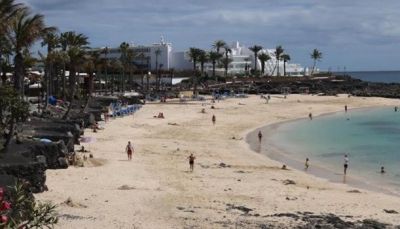
Researchers from the Higher Council for Scientific Research (CSIC) have written a report that compiles the current state of knowledge on how the SARS-CoV-2 virus, which causes the Covid-19 disease, is transmitted in spaces intended for bathing and other aquatic activities.
In their work, they warn that the large number of people in these spaces can be a source of contagion, but they point out that contagion in the aquatic environment "is very unlikely" and that the characteristics of the beaches can reduce the risk.
Another factor that may be of concern is the prevalence of the virus in the sand present on beaches or riverbanks. "Although there are no experimental studies on this, the joint action of sea water salt, solar ultraviolet radiation and the high temperature that the sand can reach are favorable for the inactivation of pathogens", they point out. In addition, they emphasize that "any form of disinfection of the beach sand must be respectful of the environment and its disinfection with the usual procedures for urban public spaces is not recommended.
The greatest risk, the crowds
"The crowds that can occur in swimming pools and beaches, as well as objects of common use, can continue to serve as a mechanism of contagion. Other possible routes of contagion reviewed are those derived from the presence of the virus in wastewater that may reach bathing water bodies and the survival of the virus from bathers in water, sand and adjacent surfaces," the researchers point out in any case.
Of the possible routes of contagion in the environments referred to in this report (swimming pools, beaches, rivers, etc.), they argue that the main route of transmission of SARS-CoV-2 is "through respiratory secretions that are generated with coughing and sneezing and person-to-person contact."
The researchers have relied on the scientific literature available to date to provide a series of indications and recommendations for spaces intended for recreational aquatic activities.
In recreational activities, infection by SARS-CoV-2 by contact with water of standard conditions for bathing is "very unlikely", they argue. "However, these activities generally involve a loss of recommended social distancing measures," they warn.
In swimming pools and spas, they indicate that the use of disinfectants "is widely implemented" in order to avoid microbial contamination of the water by the influx of users. Thus, they believe that this measure "should be sufficient for the inactivation of the virus."
The virus is reduced with high temperatures
"The aerosols generated in a spa or in a medicinal water facility will have the same disinfection characteristics as the bathing waters of these facilities. In those cases in which the environment of the facilities is maintained at high temperatures, as in the case of saunas and steam baths, it is expected that, due to the high temperature (greater than 60 ºC), the survival of the virus will be reduced," they add.
With regard to sea water, although they state that "there are currently no data on the persistence of SARS-CoV-2", the dilution effect, as well as the presence of salt, "are factors that probably contribute to a decrease in viral load and its inactivation by analogy to what happens with similar viruses."
"However, the survival of SARS-CoV-2 in river water, lakes, freshwater and untreated pools is higher compared to swimming pools and salt water and, therefore, precautions should be taken to avoid crowds, these being the most inadvisable aquatic environments in relation to other alternatives," they add.
The report has been written by six researchers from CSIC centers: Ana Allende, from the Center for Soil Science and Applied Biology of Segura (CEBAS-CSIC); Alicia de Andrés, from the Institute of Materials Science of Madrid (ICMM-CSIC); Antonio Figueras, from the Institute of Marine Research (IIM-CSIC); Gloria Sánchez, from the Institute of Agrochemistry and Food Technology (IATA-CSIC); Joan Grimalt, from the Institute of Environmental Diagnosis and Water Studies (IDAEA-CSIC); and Carlos Prieto, Deputy Vice-Presidency of Scientific-Technical areas of the CSIC.


