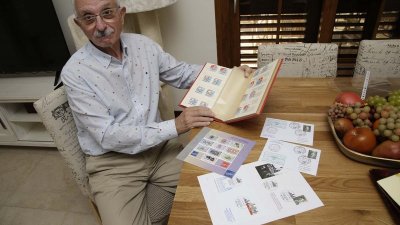
An Argentinian doctor, 70 years old, now retired and residing in Lanzarote, Carlos Court, collects stamps in his house in Costa Teguise. The man, who has been collecting them for 50 years, has been the driving force behind Correos granting him a commemorative stamp for the centenary of the birth of the Portuguese writer José Saramago and the Lanzarote artist César Manrique.
La Voz discovered the story of this philately lover and wanted to visit his special home in Costa Teguise. A property that not only houses albums with stamps, but also cat figures and different photographs of his wife and family that adorn the living room. He keeps stamps, but also welcomes stray cats, eight animals that live with him.
He has been classifying stamps as a hobby since he received a letter with many of them at his home in Argentina and contacted the address of the House of Philately of Argentina, in Buenos Aires. It was not until November 20, 1980, at the age of 27, when he began to delve deeper into this field of study, while working at the Corbeta Uruguay Scientific Base in Antarctica. "I began to relate more to philately."
The officer of the base's Health Corps was the most interested and therefore became a philatelist. "The others were not interested, even the Corporal told me I was weird," he confessed.
But years later, in 1986, when he moved to live in Spain, that hobby "fell asleep a little," he recalls. He began working in the Andalusian Health Service, met his wife and had his children. A stage he remembers with great affection. "It was the greatest success of my life." Later, he obtained his position in the Canary Health Service, specifically in Lanzarote. At that time, "I didn't have much time to dedicate to philately," he acknowledges.
It was a cardiovascular accident that brought him closer to that passion. The former medical director of the Molina Orosa Hospital is very clear that philately saved his life. He had a heart condition in 2020, which almost led to his death, and after 38 years of profession, he had to leave his job. His only refuge was being a stamp collector. "Philately was encouraged as a result of the accident," he explained to the newspaper. So much so that he relates very excitedly: "I never imagined that I was going to have a heart attack, if they hadn't sent me to Madrid, I wouldn't have been able to go to the presentation of the Saramago stamp and I wouldn't be here telling my story either."
"I never imagined that I was going to have a heart attack, if they hadn't sent me to Madrid, I wouldn't have been able to go to the presentation of the Saramago stamp"
His most special stamps: from Saramago to César Manrique
Another of the artists he wanted to give voice to was César Manrique. Together with the foundation, he asked Correos for a stamp dedicated to the undisputed protagonist of Lanzarote. As with Saramago, there was also a presentation in July 2019.
During the talk, he recounts how he had the great idea of promoting the creation of that stamp. "I realized that Saramago didn't have any stamps and I wrote a letter to the philatelic commission of the State," in which he made the request, coinciding with the anniversary of the writer's birth. Later, he obtained a positive response. "They told me that they were going to value it, that it was interesting to release it," revealed the man sitting on the sofa in his house.
After approaching the Ministry of Development, taking advantage of a trip to Madrid, they told him that "the stamp was going to be approved for 2023." At which point he came up with the idea of holding a presentation at Saramago's house. "I went to the House-Museum and proposed to do it there," he revealed. He wanted that on this occasion, "it would be done outside of Madrid."
A presentation that for Saramago's acquaintance was "very emotional." He tells the relationship he had with the writer. "I met Saramago personally, I spoke with him on many occasions, I even have a book of his," he acknowledges. They met at his workplace. "We met when he went to the Molina Orosa hospital." Although he is more of a science man than a literature man, he makes clear what surprised him about the Portuguese. "I have always been struck by the way he wrote."
"I met Saramago personally, I spoke with him on many occasions, I even have a book of his"
Court acknowledges that the stamp he likes the most is the one of Saramago. For the philatelist, what stands out the most is the writer's appearance. "He looks very good, also, just at a time when he was not in good health," he says. What he likes the least about the collection is the two black and white postcards that have been taken of him, he says they are "too dark and gloomy."
He confesses the amount that a philately enthusiast can pay to get a stamp. "They can cost up to 5,000 euros." They are so valuable that "he doesn't usually sell his stamps," although sometimes, "I make copies and send them to some philatelic acquaintances." From his experience in the field, the "theme is the most important thing" when choosing the stamp, which is what "makes it special," he points out. The image must "be beautiful and represent something special" for each one, he advises when getting a stamp.
As a good specialist in collecting stamps related to Antarctica, he has in his album different postmarks of the penguins that live on the continent. They are followed by stamps of native birds of Australia such as the blue penguin or better known as the little penguin (Eudyptula minor). In addition, in the world of royalty, there are some stamps of Lady Di, Princess Diana of Wales.
Exhibition of his Lanzarote collections
He still has more pending work for next year. The most special, to make an exhibition of philately and maximophilia with all the collections he has about Lanzarote. "I want to present everything," he has advanced.
Among his future plans, he wants to continue with maximophilia, taking advantage of the stamps and getting the postmark with the anniversary of operation and opening of some places. The sites he is missing are the Mirador del Río, Jameos del Agua and the Jardín de Cactus. In addition, he still "needs to investigate the 'Catálogo Edificil Sellos de España'", to see if he "finds something more of Lanzarote", he pointed out.
Manrique and Saramago are not the only personalities who are going to have their personalized stamp. He is trying to promote two stamp requests: that of Isla Cacho in Antarctica and a stamp in homage to Fidel Pagés, a military doctor of the 20th century, who put into practice the epidural in Spain. "A man almost forgotten, who made a great advance for civil society, in particular, for women," concludes Court.
Add La Voz de Lanzarote as a preferred Google source.
Stay informed with the latest current news.