
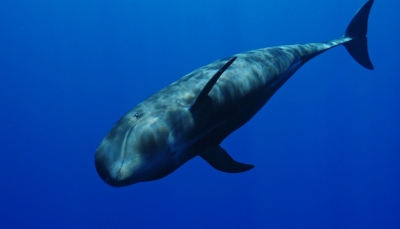
Nika, a tropical whale of the community that lives in the Teno - Rasca Special Conservation Zone, in Tenerife, establishes an unusual relationship with the videographer and expert in Marine Sciences Felipe Ravina, through which the viewer will be able to delve into the dangers faced by the population of the world's most important tropical whales, which is located in this area of the island.
The short film, directed by José Hernández, director at the production company MINSK, and Felipe Ravina Olivares and distributed by Kinema Producciones, seeks to move consciences and promote change towards a real sustainable development, with a future in which coexistence with nature allows us to continue enjoying the Canary Islands in its wild and natural state.
This documentary, with just a few days of run, has already been awarded the Golden Railing of CimaSub, the first prize of the most prestigious festival in Spain of short films and marine documentaries, also known as the Goya of marine documentaries.
The piece reflects on the risks to which humans have subjected tropical whales, as a result of the overexploitation to which Tenerife is subjected and the unsustainable way in which the island has been managed in recent decades. This model based on infinite growth is not only threatening natural spaces and their biodiversity more than ever, but also the coexistence and local development of the Canarians, and has turned this refuge into a place full of dangers for animals.
The short documentary Nika, the tropical whale is a story from you to you and between species, inside and outside the water, in which a tropical whale and the documentalist, scientific disseminator and graduate in Marine Sciences, Felipe Ravina, seem to engage in a conversation that invites a deep reflection on the overexploitation and the disastrous management of the territory.
The documentary, co-directed by the Canarians, also features the president of Calderones de Canarias, Mirna Piñero, and the cetacean sighting guide of the Bonadea II, Sergio Hernández, part of a story that excites and shows the harsh reality of destruction and deterioration that the archipelago's ecosystems are suffering due to the mismanagement of the public administrations of the Canary Islands.
Unique pre-release in the Canary Islands
This documentary, recent first prize of the Cimasub 2024, will be screened in a unique pre-release in the Canary Islands, and will be on November 5 in the auditorium of the University of La Laguna in Tenerife, in an event that will have a general admission price of six euros and where we can be with the authors and protagonists. This presentation on its island, which has the collaboration of the University of La Laguna and its Vice-Rectorate of Culture, will be the starting gun for a tour of festivals around the world by the hand of the Canarian production company Kinema Producciones.
Nika, the tropical whale can also be seen at the International Underwater Film Cycle of Donostia - San Sebastián, which celebrates its 46th edition this year during the days 21, 22 and 23 of November in San Sebastián.
"A documentary that penetrates and creates awareness"
Nika, the tropical whale will "penetrate deeply into the heart of each viewer and create awareness" because "the paradise in which we live is not going through its best moment, and this reality not only affects people, but also generates a pressure that is not sustainable on the ecosystem."
This is how the co-director of the documentary José Hernández has defined it, who has confessed his "enormous joy" for being the Golden Railing of Cimasub 2024 in the first weeks of the short's tour. In total, more than 300 works from all over the world were presented in this contest in which Nika: the tropical whale has been the winner in the documentary category. In addition, with this work Felipe Ravina doubles, since it is the second time in three years that Ravina has won this award.
"It is a pride and an enormous satisfaction to receive this award again. And receiving it with a work that shows the reality of what is happening in the Canary Islands makes it even more special," Ravina celebrated.


