
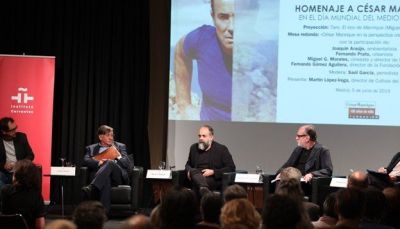
Last June 5, World Environment Day, the Cervantes Institute held an event at its headquarters in Madrid to pay tribute to César Manrique within the framework of the centenary of his birth, highlighting his activist and environmental side, as an artist committed to the defense of the territory, the landscape and nature.
The event, which was jointly organized by the Cervantes Institute and the César Manrique Foundation, began with the screening of the film 'Taro: The Echo of Manrique' by filmmaker Miguel G. Morales, before an audience of more than a hundred people. It continued with a round table in which Morales himself, the director of the César Manrique Foundation (FCM), Fernando Gómez Aguilera, the naturalist Joaquín Araújo and the urban planner Fernando Prats participated. Martín López-Vega, director of culture of the Cervantes Institute, opened the event: "Few like César Manrique teach us that coexistence with nature is a supreme value," he said.
The journalist Saúl García, who moderated the table, raised the relevance of looking to art to find answers to the challenge of climate change and the absence of world leadership. For his part, Miguel G. Morales, pointed out that César "showed a glimpse of utopia" and that his message arrives because it connects "with our most primary drives." "His message is to teach us to see, to make us participants in the search for beauty and enlists us as combatants for a better future," he said.
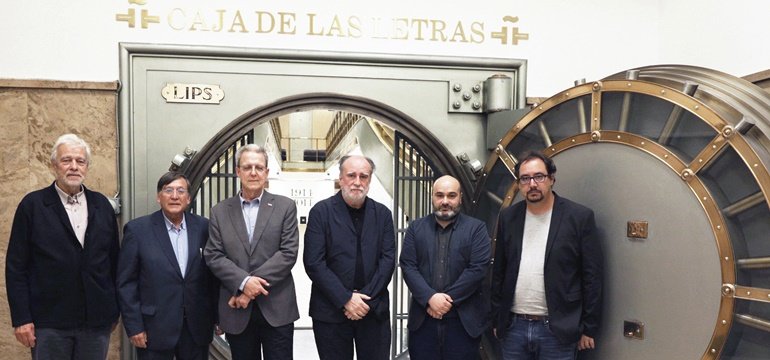
Joaquín Araújo stated that "ecological thinking is the riskiest" because it means facing the interests that intend to "devour the landscape", and pointed out that César "was a solitary voice that intended something that is beginning to be glimpsed as possible: to terrify the powers of this world". He assured that Manrique offered the example that for environmentalism "there is little more beautiful than dedicating life to defending life".
A César "who denounced and created"
For his part, Fernando Prats, drafter of the Island Plan of Lanzarote of 1991, which declassified about 300,000 places, pointed out that "César Manrique is yet to be discovered" and that there are texts of his that are absolutely valid today. He told about his experience with the PIO of Lanzarote and assured that it was a "daring" work, which tried to put into practice César's discourse and that it was possible because there was a story "of César who denounced and created" and because "the vast majority of society understood it, understood it and supported it".
"We only put our technical knowledge to try to develop that project. César created for a time not only a territory but a society in which the population was in charge above economic interests," said Prats, who indicated that the PIO gave value to the relationship between ethics and aesthetics and to "how beautiful simplicity is" and assured that later, with the passage of the years, almost all the collaborators of his team on the Island were retaliated against. Likewise, Prats also affirmed that art and culture are essential as a motor for change, to "see incredible futures".
Manrique and his claim for a social function for art
As for Gómez Aguilera, he thanked the Cervantes Institute for incorporating into the heritage of the language a parcel of knowledge as decisive today as nature. "One of our great contemporary challenges is reality since we are dominated by visuality but not by reality, increasingly hidden and deformed," said the director of the FCM, who explained how César Manrique, who insisted on discovering and shaping the essential reality of Lanzarote, practiced disciplines that were not understood at the time, so he is an artist "dislodged, outside the common categories of art history".
In Gómez Aguilera's opinion, he calls for a critical approach from a perspective of freedom and not academic, from a transversal and unprejudiced perspective, as the new generations are practicing. "He was more than an artist, he overflowed what is conventionally understood by artist because he claimed a social function for art, applied in a very singular way to transform the territory and forge an economic model that, formatting the territory from art and culture, would radically change the life of an entire community," said the director of the FCM, who explained that it was a project he shared with the public administration, forming "a prodigious cell" with José Ramírez Cerdá, creators of a modern cultural heritage for Lanzarote as relevant and original as the pre-existing natural one.
The second death of César Manrique or a resurrection?
The moderator asked if we are witnessing, as Saramago affirmed, the second death of César Manrique or a resurrection, for his legacy. For Araújo, "new panoramas are dawning" and the current moment "is excellent to know the figure of César" because his trajectory can be "the great antidote to the health diagnosis of the planet, which is terrible" and is called to play an even more important role than he played in the past. "There is no possibility of change without appealing to concrete examples, ecological culture is the only one that can get us out of this quagmire and needs mirrors, references," he assured, and pointed out the "fundamental role of the FCM".
Prats agreed on the importance of the Foundation's work, "to which we owe a lot", and insisted on the role of art as a mobilizing agent for change: "In the democratic struggles in Spain we could have very clear ideas, but those who took us to the streets and moved us were the singer-songwriters or the poets". "César has not died, he has heirs, and if we do not go towards catastrophe, that rebirth will elevate him to the world that corresponds to him as a person capable of giving positive solutions," he indicated.
Finally, Gómez Aguilera pointed out that we must turn our eyes to cultural references and that "the personalities of culture are not worth so much for what they are, even being and worth a lot, but for their ability to stimulate the individual and community construction of the present". He stressed that now more keys are handled to understand César Manrique and that the processes of change must be shared because very different directions coexist, but that cultural and social beacons have not lost validity, which we need. From that perspective, he concluded, that "César has much to offer us, we need strong, critical and passionate references and leaderships like his". "We accumulate more and more knowledge, but we lose passion and without passion knowledge is less powerful," he said.


