
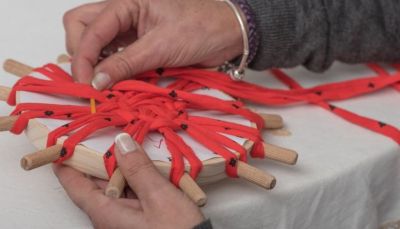
The Cabildo of Lanzarote has agreed to adhere to and support the proposal of the Cabildo of Tenerife for the rosette technique that is still practiced on both islands, called Tenerife Lace, to be declared an Asset of Cultural Interest of the Canary Islands.
“It is absolutely necessary to protect and value this traditional trade that crossed the borders of the islands, and to recognize those who today keep alive the legacy of those women who, with their work, effort and ingenuity, became the pillar of the economy of many families in the archipelago,” says the president of the Cabildo and Minister of Heritage, María Dolores Corujo.
The rosette/Tenerife Lace manufacturing technique began to develop throughout the archipelago from the first Castilian settlers, with Tenerife and Lanzarote being the islands where this activity is still maintained.
At the end of the 19th century, the large commercial houses based in Puerto de la Cruz began exporting it abroad. From there, boats loaded with rosettes made mainly in Tenerife and Lanzarote left for the large European ports, which meant the great expansion of a business that until then had been domestic.
The great benefits provided by a product that began to be called Tenerife Lace in home magazines and books dedicated to British textiles led many rural women to dedicate themselves to it. In Lanzarote, in fact, it is estimated that some 2,000 women made rosettes in their homes to contribute to the family economy.
Competition and, above all, the outbreak of the First World War (1914) slowed down maritime traffic and, therefore, an industry that was booming and “highly profitable”, the Cabildo recalls.
After the Spanish Civil War, work from home became important again. Workshops were then organized in which forms and styles that would otherwise have been lost were taught and which are preserved thanks to the efforts of many artisans from the islands.
Since the mid-20th century, there has been talk of Tenerife lace or Tenerife Lace in America and Europe. Various investigations indicate that behind the Ñanduti, from Paraguay; the Soles de Maracaibo, in Venezuela; the Soles de Naranjito or Moca, in Puerto Rico; the Motivi, from the island of Hvar, in Croatia, and the rosettes of Louisiana is the hand of the women who left the islands in the different migratory waves that reached America, Asia and Europe.


