
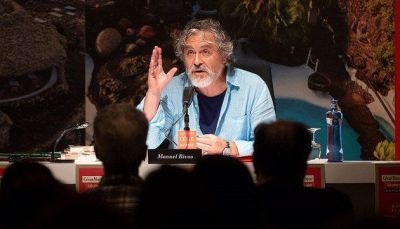
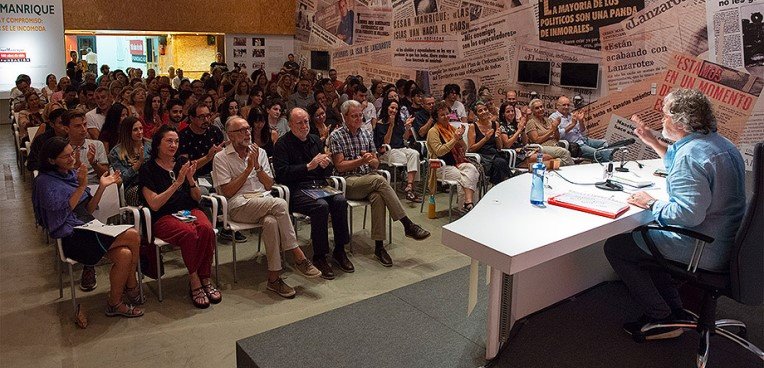
"I have the feeling of being in an authentic place? because the César Manrique Foundation is a pioneer in many things that are now part of a common conversation." "As poetry protects its own, the name of the César Manrique Foundation protects its people." The writer Manuel Rivas began his lecture, on October 1, on "the mouth of literature" by referring to the place where he was, "a place to renew that secret pact between generations that allows us to recognize injustices", the José Saramago room, and recalled that he made the Portuguese Nobel one of the last interviews he gave in which he reminded him that death also devours words, and that words had helped him to stand up.
Rivas, a founding member of Greenpeace and always concerned about the environment, pointed out that "we are a cliffed planet with the feeling that they are stealing the horizon line from us" and advanced that the process of degradation of nature also occurs in language: "Words are like the most vulnerable beings in nature", although they also help us to get up from the ground, when they make up an insurgent literature, not a literature "of karaoke", "of cloning", but rather acts as a condition to be able to fight against fear, "and the main fear is the fear of abandonment, which appears in many stories and novels." Traditional children's stories provoke fear. They have a training function, apart from entertainment. You open the book, and the book opens you? in a kind of erotic struggle.
"We think that the mouth of literature is in books, and yes, the seed may be there, but I like to question that idea." Literature is also in other places. Rivas recounted several anecdotes referring to where he has encountered the mouth of literature. The first time he encountered that mouth was at the age of three, in his house, a low house in the Montealto neighborhood of A Coruña, where he played in a triangle-shaped lot that had, on one side, the cemetery, on the other, the prison, on the other, a pasture with cows and in front, the Tower of Hercules, a lighthouse like his older sister, who warned him that day to look out the window to see a parade of musicians and acrobats pass by. Two terrible faces rested against the window and the children locked themselves in the bathroom, fearing the abandonment of their mother, who when she arrived told them: "They were the big heads; the Catholic Monarchs." "A phrase that summarizes the history of Spain." "That our first fear is the kings is predestination, in six words is the mouth of literature," said the writer.
His mother, as a child, frequented the house of the niece of the priest, who had a parrot named Pío Nono who spoke Latin (ora pro nobis). As they took him out to the balcony "he came into contact with the mouth of literature" and the pine trees of Altamira taught him to celebrate anarchy. The day the parrot was heard saying "Long live anarchy" was the last day he was seen on the balcony. It was 1936.
The mouth of literature was also in school. His first teacher was called White Horse and he was a fearsome man, who told them that they spoke badly because they spoke in Galician. One day he asked them what they wanted to be when they grew up and one answered "emigrant". That answer unbalanced the teacher. For Rivas, "it was the mouth of literature that responded, and the first thing it does is cause an imbalance and question our convictions, see what is not well seen or what is hidden." The second teacher, Don Antonio, suspended classes to take the students to the bar to see the legendary boxing matches. "Those were his master classes, which prepared us for life." The journey of the mouth of literature achieves a suture between reality and fiction, "which is one more circle of reality."
Another mouth of literature is ornithomancy, divining reality through the behavior of birds. His two grandfathers lived stories of that type. One, found two hoopoes fighting to the death, tried to separate them with his cane but could not, and days later the Civil War began. The other stopped talking after the war. He only said "boh", but one day he told a story about how a priest, who had been mocked by a group of young workers, advanced the uprising: "We'll see how you sing in the middle of the month." "There is the mouth of literature, in the clash between a worker's joke and his angry reaction." He also broke his silence to announce his death, when he said. "If the cuckoo does not sing in March or April either the cuckoo is dead or the end is coming."
Manuel Rivas ended his talk by pointing out that the main instrument of writing is listening, "there is no comparable tool." He also appealed to memory, to Mnemosyne, his goddess, mother of creative processes. "Talking about literature is also talking about memory, it is not possible to be free without memory. Memory is a rescue process, it is an activism. We are what we remember, but also what we do not remember." The mouth of literature, which speaks to us in decisive moments of life, converted into memory, leads us to concentric circles, to a point that is a meeting place of antonyms. Custodying the meaning of words is an obligation of literature. Although, as Flaubert replied to George Sand, who had asked him why he did not console her with his literature, instead of disconsoling her, "the important thing in literature is nuance." "The first commitment of the writer is to write, I am passionate about it, but you have to be a sleepwalker, you don't have to have a schedule, and you have to know that anything you write is going to compromise you," Rivas concluded.


