
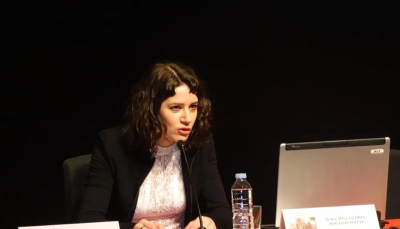
Gloria Poyatos, magistrate of the Social Chamber of the Superior Court of Justice of the Canary Islands, belongs to the Association of Women Judges of Spain that has written Daughters of Fear, a book about gender violence. This Friday she was on the program Buenos días, Lanzarote of Radio Lanzarote - Onda Cero to talk more about this work.
This book "tries to address justice in a way that has never been done before, we wanted to make visible different faces of gender violence and do it from our experiences as magistrates as responsible", explains Poyatos.
What they intend is that people understand, without legal terms, everything that surrounds this issue. "What we do is a work from within, that is, to externalize professional experiences linked to gender violence in a plain and simple way," reveals the magistrate.
"In fact, the way we explain and address cases of gender violence has nothing to do with the sentences, it is a close and human way of telling what those terrible situations cause us when we address them for professional reasons, how they erode us, how they affect us and how many cases make us end up crying," she says. "The key is to bring justice closer to the citizens, in such a didactic way," she says.
"The idea of creating the book arose spontaneously in the monthly book club that we have where we analyze works by female writers and share experiences from the courthouse. That's when we decided to write a book that was not legal, but had stories to be understood by people and that impact, because at the same time we make progress in the approach against violence," she indicates.
"In the elaboration of the book there was no distribution and we did not repeat ourselves, and I anticipate that there are real stories that have suffered on a personal or family level, in addition to professional," she continues.
In addition, Poyatos explains that "all the names we give in the book are false and the process has not cost us so much because our philosophy of doing justice rests on a justice with a human rights perspective in an empathetic and close way, therefore, what we have done there is what we advocate as an association, we bet because justice ceases to be distant and intelligible and that people arrive at the court and feel comfortable because it is terribly traumatic to have to go to a court and face the coldness of those black robes".
"This book is also a bit self-critical, that is, by telling real experiences of situations that victims may encounter because there are some of them who have told the story in the first person," she explains.
Inside the book different stories of the victims are told. "There are very hard stories and I would say that the hardest is the one explained by a prosecutor who is the story told by a child who was murdered by his father, entitled The gaze of Aarón. That child was five years old, the father murdered the mother in front of the child and then strangled the minor," she reveals.
"Another very hard story is the case of a girl who was a victim of vicarious violence in a home where her father abused her mother and what the minor did to stop the screams and abuse was to throw herself from the bunk to the floor and hurting herself," she declares.
"I think we have to do much more and we have to do it from society and from education in equality and, of course, from justice because another closer justice is possible to encourage people to address us with tranquility, calm and that does not pose a challenge to have to manifest you. In addition, also aspire to a victim-centered justice, which places the victim in the center that have been historically forgotten," she concludes.
Add La Voz de Lanzarote as a preferred Google source.
Stay informed with the latest current news.


