
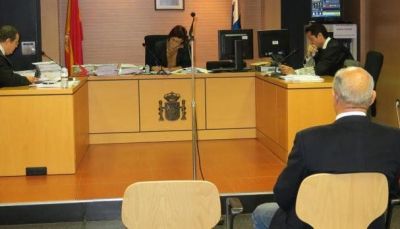
The statement given by one of the witnesses during the Los Rostros trial "can only be described as a mockery of the Administration of Justice." That is what the judge of the Criminal Court Number 1 of Arrecife, Margarita Gómez, maintains, who has ordered that proceedings be opened against this witness, David Gutiérrez Marichal, since she considers that he may have incurred in a crime of perjury.
In the conviction against Dimas Martín, the magistrate points out that this witness, who claimed to be a friend of the historical leader of the PIL, gave a statement that was “meager, partial, and with deliberate and unbelievable gaps”. And all this despite “having been warned of the possibility of incurring the crime of perjury, insisting despite this on answering reluctantly or to things other than what he was asked, pretending not to understand the clear and uncomplicated questions that the Public Prosecutor's Office asked him,” the judge points out, recalling that she herself warned the witness during his statement.
Gutiérrez Marichal was called to testify in the trial as the person responsible for the execution of the works in Dimas Martín's family home, but during the visit he repeated over and over again that he did not remember anything. Not having gone to the farm, nor what he had gone for, nor who he was going to meet with. He did not even recognize his voice in the telephone conversations that were heard during the trial, and that were intercepted by the UCO within the investigation of the Unión case.
"It is clear that he was doing work on the defendant's construction"
“Despite his efforts to evade the questions that were asked of him, it is clear that he was doing work on the defendant's construction,” the magistrate points out in the sentence, adding that it is irrelevant whether he did it “out of friendship” or “as a paid job,” which is what the witness most vehemently denied.
The magistrate recalls that when an agent of the Civil Guard went to carry out an inspection of the works of Los Rostros in 2009, the person he found there was David Gutiérrez Marichal, who “identified himself as the person in charge of the works.” However, in the trial, after having first said that he did not remember having gone on that date, he ended up pointing out that “he was not on the farm, but arriving at the farm, and that the agent stopped him without further ado when he was walking, asking him who he was,” as the judge reproduces in the sentence.
In addition, he also refers to the telephone conversations that the prosecutor asked to be heard during the statement of this witness, given his “memory problems” to remember the facts for which he was being asked. And in those conversations, he is heard talking to Dimas Martín, who “asks him about the progress of the work, giving him instructions on it.” However, the witness's response then was to state that “he does not recognize himself in the hearing.” “And he answers the question of whether that is his voice that ‘it will be’, adding that he has never had such a long conversation, referring to the fact that it lasted more than a minute,” the magistrate emphasizes.
"He replied that he has a disease, but that he does not remember which one"
In addition, the sentence also recalls that the prosecutor Javier Ródenas even asked the witness “about his lack of memory and if he had a diagnosed disease in this regard,” to which Gutiérrez Marichal “replied that yes, but that he does not remember what disease and ends his intervention by pointing out that all he has heard after the hearing is rain.”
For all these reasons, the magistrate asks that testimony be deducted from what happened in the trial and that proceedings be opened to investigate him for the crime of perjury. In this regard, she emphasizes the “great importance” of the testimony of witnesses in the trial and recalls that in the Penal Code it is punished “to substantially and maliciously fail to tell the truth.”
Specifically, the judge considers that he could have incurred in a crime typified in article 460, which applies “when the witness, expert or interpreter, without substantially failing to tell the truth, alters it with reticence, inaccuracies or by silencing relevant facts or data that were known to him.” For these cases, penalties of “a fine of six to twelve months and, where appropriate, suspension from employment or public office, profession or trade, from six months to three years” are contemplated.


