
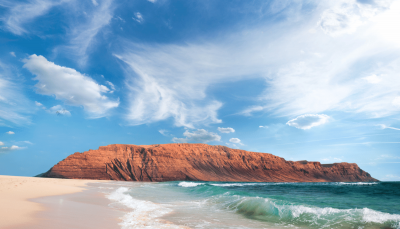
La Graciosa is the smallest populated Canary Island of all. In its 29 square kilometers, more than 700 people live. A traditionally fishing area has seen how the number of tourists increases year after year, reaching more than 550,000 entries to the island only in 2022.
The increase in arrivals "overwhelms" in a "systematic" way the capacity that the eighth island has to respond to the demand for energy and water, the management of waste and sewage or land mobility within it. This is stated in the report of the Energy Community El Sol de La Graciosa, the project selected by the European body Clean Energy for EU Island to achieve the total decarbonization of the island in 2030.
This initiative aims to turn La Graciosa into "an international benchmark" in improving the quality of life of its inhabitants and visitors, as well as reducing economic costs, advancing the fight against climate change, decarbonization and self-consumption.
History of supply in La Graciosa
This initiative highlights that the growth of infrastructure on the eighth island has not been part of a plan, but "random jumps". Between 1943 and 1945, in La Graciosa three cisterns were built in Caleta de Sebo and another in Pedro Barba to meet the demand for water, which were added to the home cisterns and a trough that was already installed for livestock. In the years with less rainfall, the town was supplied with cistern barges that the army brought to the island, as well as from the Guza spring in Risco de Famara.
In that period, rubble and garbage were thrown in different parts of La Graciosa, there was no light and energy was obtained from the wind and the burning of bushes. In 1977, the first desalination plant was installed in La Graciosa, with the capacity to desalinate 75 cubic meters of water per day. It offered water, but also energy for 12 hours and with it all the houses with a meter in the town were supplied.
After that, according to the aforementioned report, "the third jump" took place in the eighties. In this period, "the electricity generators were kept running 24 hours". To which is added that in the mid-decade the power line arrives from Lanzarote to La Graciosa.
The fourth advance, for this report, was the connection of both islands by an underwater pipeline to supply water to La Graciosa and disconnect the desalination plant. In this same period, the ports of Órzola and the eighth island were expanded and "contributed to the fixation and increase of the resident population and the tourist development of the island".
The immediate future
The Energy Community El Sol de La Graciosa highlights that this 2024 could achieve "a fifth jump towards a more sustainable and less dependent model", giving priority to renewable energies.
This initiative proposes the collection of water through a water collection system adapted to the environment and its protection requirements, a reverse osmosis desalination plant powered by renewable energy, building a sanitation system with a purification "as ecological as possible" and a water regeneration process, to be able to use it in agriculture.
In this way, the energy community proposes to generate "the maximum of electrical energy" with renewable energies that supply private homes, industries, businesses and public infrastructures. In addition, it establishes that there are methods of collecting garbage, furniture, other materials and their subsequent recycling, to avoid the farms of rubble and garbage that already exist on the island.
El Sol de La Graciosa also proposes to return to private cisterns and the construction of public cisterns to store potable water and distribute it, as well as to take care of the reserves and take advantage of rainwater. All this, without giving up the water supply between Lanzarote and the eighth island, for safety.
To achieve these objectives, La Graciosa will investigate in two comprehensive studies: an engineering study to establish a drinking water and desalination plant and another on the evaluation of the specific regulation of the island. They should investigate the management of resources from sustainability and minimizing their environmental impact.
The black wells
Most of the houses in La Graciosa have "black wells", where sewage is concentrated. However, this initiative highlights that these infrastructures are filled more and more frequently and the remains must be transferred in a tanker truck to Lanzarote. In addition to generating "numerous leaks" to the soil and the sea.
La Graciosa still does not have a current purification system, although its installation was approved in 2016. Last December, the Government of the Canary Islands announced that it would declare the treatment plant project "of general interest", but Sol de La Graciosa points out that it was not contemplated that it would be used with renewable energies and proposes to "reconsider" this option.
Regarding waste, this work considers "insufficient" the transfer plant that the Cabildo de Lanzarote has on the island. In addition, there is no clean point, there is only collection of furniture twice a month organized by the City Council of Teguise, according to this initiative. While the waste from construction works occupies "public roads or spaces enabled during the works and, once finished, are transferred to Lanzarote".
"The transfer to Lanzarote is conditioned both by the lack of means, as well as by the high production of waste and the low level of separation at source", reveals this project.
Link to the full project.


