
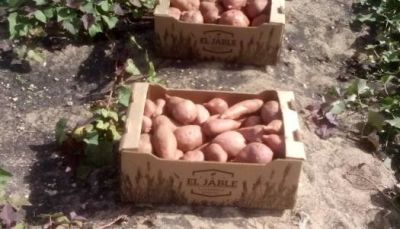
The Agrarian Transformation Society SAT El Jable, formed by "Lanzarote farmers who conserve dryland agricultural ecosystems", has analyzed the situation of the sector in an article, with an important dose of self-criticism. But above all, it proposes the measures that it believes should be adopted for the survival of the primary sector and to achieve fair prices. And for this, it starts from a question:
What can be done so that the farmer, here in Lanzarote, gets an optimal price for the sale of his crops?
In order to answer this question, we would have to focus our attention on the practices that have been developed in the past and that have prevented us from achieving the objective of achieving decent prices for the women and men of the countryside. And what could these practices have been? If we take as a reference what has been happening with onions, but which can also be applied to potatoes, sweet potatoes and other crops, we can highlight the following:
-Deliver the onions as it has been done until now (each one on their own and without a price), to wholesalers, exporters and supermarket chains.
-Compete among ourselves by offering or accepting, which is the same, lower and lower prices campaign after campaign.
- Not being rigorous in the selection of the quality of the product or in its presentation, by serving onions that are not suitable for the market or by using broken or damaged boxes because of: "total at the price they are going to pay me" and/or "by the time they are going to pay me, it's fine like this."
-Not eliminating once and for all the double standard with which we sometimes act, since when we plant to sell, it doesn't matter how many times we sulfate or irrigate with poor quality water, but if it is for our own consumption, then we hardly use sulfur and we always irrigate with good water.
-Wanting to continue selling our crops without "the tax authorities finding out."
Of course, we are not going to achieve it with these tricks, with these practices, which we must banish, we will not go far in the initial claim that the work of the countryside is reasonably rewarded, but rather what is going to be achieved is the opposite effect and that less and less is cultivated and, therefore, the lands are abandoned more and more.
How then can the farmer get decent prices?
1st.- Mainly, unifying the commercialization of our crops, for which it will be necessary to be integrated into a cooperative (a word proscribed on this island due to the unfortunate experiences lived years ago). A cooperative that cannot function under the parameters with which it has moved in the past, such as: its excessive, at times, politicization; or the unfair treatment, at other times, given by its own members by allocating their good quality products to the exporter-intermediary, and only taking the defective or poor quality ones that the market no longer wanted to the cooperative.
2nd.- Accepting the challenge that when there is no price that decently rewards the work done, we will have to throw away, if we say it well, throw away the onions; or don't we do it when we deliver them without a price? Or haven't we seen it done in Tenerife, Gran Canaria or La Palma when their farmers have dumped their bananas or tomatoes in the ravines demanding fair prices?
3rd.- Always improving the quality of the product through a good selection of seeds. Perhaps in the search for this objective we have to renounce the garlic that has done so much damage to the onion, for not carrying out a good classification of the bulbs or when they are often harvested green to be the first to sell and thus obtain a better price.
4th.- Programming the crops, because we must be aware that before deciding how many pounds of spring onions are going to be prepared, we have to identify the market to which we are going to allocate our harvest to know the volume of kilos that said market can consume.
5th.- Trying to mechanize the crop but respecting, of course, the fragility of our soils. All this in order to avoid, as far as possible, the costs involved in planting by hand.
But of all the measures pointed out, there is one that stands out above the others due to its tremendous importance in order to achieve the desired end, and that is that: "we have to unify commercialization." To confirm this evidence, let's go back to looking outside of Lanzarote. If we look at the banana sector in the Canary Islands, we do not see farmers individually selling their bananas, but rather all of them associated with a s.a.t. or a cooperative, to then appreciate how some and others join a banana producers' organization, to finally see how the six banana producing organizations existing in the Canary Islands are integrated into ASPROCAN. Logically, all these unions or associations are carried out with the sole purpose of getting the best price for the farmer in the sale of bananas. We do not believe that the importance, economic vitality and institutional influence of the world of bananas can be questioned, both in the Canary Islands, Spain and even in the European Union itself.
In short, there is no other way to achieve the initial objective (decent prices for the women and men of the countryside) than to fight for the union of the island's countryside; any other way is doomed to failure as history never tires of teaching us again and again; because it is well known: "a people that ignores the bad experiences of the past may be condemned to relive them", and we think that we should not forget them nor repeat them.


