
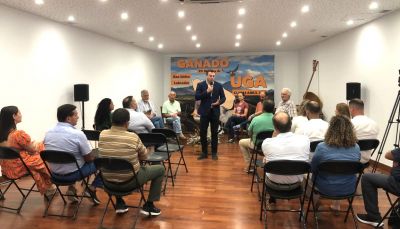
The Yaiza City Council proposed last weekend spaces for analysis and reflection during the celebration of the Uga Livestock Fair. Among them, it held a colloquium on organic livestock farming with the participation of technicians and workers from the primary sector of Lanzarote who today operate the island's organic farms.
During the event, the technical foreman of the Cabildo de La Palma, Andrés Rodríguez, an expert in the management of organic by-products of agricultural, livestock and forestry origin, participated, summarizing the 20-year experience of the Sustainable Agriculture Program of Isla Bonita.
Apart from the subsidies from the competent institutions, the debate raised the implementation of the Lanzarote forage plan as a real stimulus for the arrival of new workers to the primary sector or the transition of conventional livestock farms to organic livestock farming. Without ignoring the lack of rain in Lanzarote and the prolonged drought situation, the objective is for farmers to be as self-sufficient as possible in the production of supplements for their animals' feed: "that the farm itself plants its forages".
The Lanzarote forage plan already studied years ago the viability of native and foreign species. "We are at an appropriate time to give it a boost, put it into practice and supply that forage to all the farmers so that they see that there they have an opportunity. Right now, Quesería El Faro, being conventional, is betting on producing its own green forage," said Teno Osorio, professor of FP Ecoagriculture at IES Teguise.
The work is joint, there must be institutions, technicians, winners, farmers and researchers. Livestock farming cannot be understood without agriculture and vice versa and in the Canary Islands, and in particular in Lanzarote, there is a serious problem of loss of organic matter from the soil, "waste is not being used well".
The Sustainable Agriculture Program of La Palma helps conventional farmers to take the step to organic agriculture and seeks specific solutions to the problems posed by each farm. Since 2009, European aid has been much more conditioned to waste management, then, 30% of the farms in the Canary Islands were in trouble due to the demands of the Union.
La Palma's approach was to transform that problem, that of agricultural, livestock and forestry waste, into a solution. Andrés Rodríguez asks, "what does a cheese factory do with the whey?, what happens to the manure from the animals, with the pruning of gardens or with the separation of organic matter at home?, or "what is done with the management of liquids or does everything go down the ravine?" La Palma made a map adapted to the needs of each worker in the primary sector based on the concerns of those interested.
"We are interested in the method of researcher Ildefonso Acosta to obtain quality fertilizers using whey, slurry and other waste, but according to the needs of the soil of each farmer," Rodríguez pointed out. This reduces dependence on external inputs and promotes the development of a more environmentally friendly agriculture. La Palma also conducts domestic composting courses and these same experiences are transferred to educational centers.
Exposed these and other difficulties, the work of the primary sector and those who dedicate themselves to organic agriculture and livestock farming in Lanzarote is commendable, also burdened by the management of the integral water cycle. The young María Guerra, with only 23 years old, manages a poultry farm in Tinajo: "It is difficult to feed the animals, so I take advantage of leftover lettuce or chard, but the hen needs grain to produce eggs and I am forced to buy feed from outside".
The veteran organic farmer Manuel Peláez, for his part, claimed the yield of the product of the field and its nutritional properties, thus, he stressed that "the organic product is health, it is free of toxins and on top of that it gives a yield of 20 or 25% more than the conventional one".
The organic beekeeper Klaus Guttenberger said that the activity he develops "is a complement because I cannot live exclusively from it. The yield per hive cannot be compared with other islands. In the Canary Islands as a whole we are only about 20 organic beekeepers".
Óscar Noda, mayor of Yaiza, appreciates the contributions of all the participants in this debate in Uga that was broadcast in streaming and that can be viewed by typing Coloquio Ecoganadería in the Youtube search engine. "We all learned, it reminded us that we continue with problems of ten and more years, that organic livestock farming needs much more attention due to the requirements in farm facilities, animal feed, availability of the territory and management and use of waste, extremes that demand more technical attention from the Cabildo de Lanzarote and the Government of the Canary Islands with the involvement of the town councils".


