
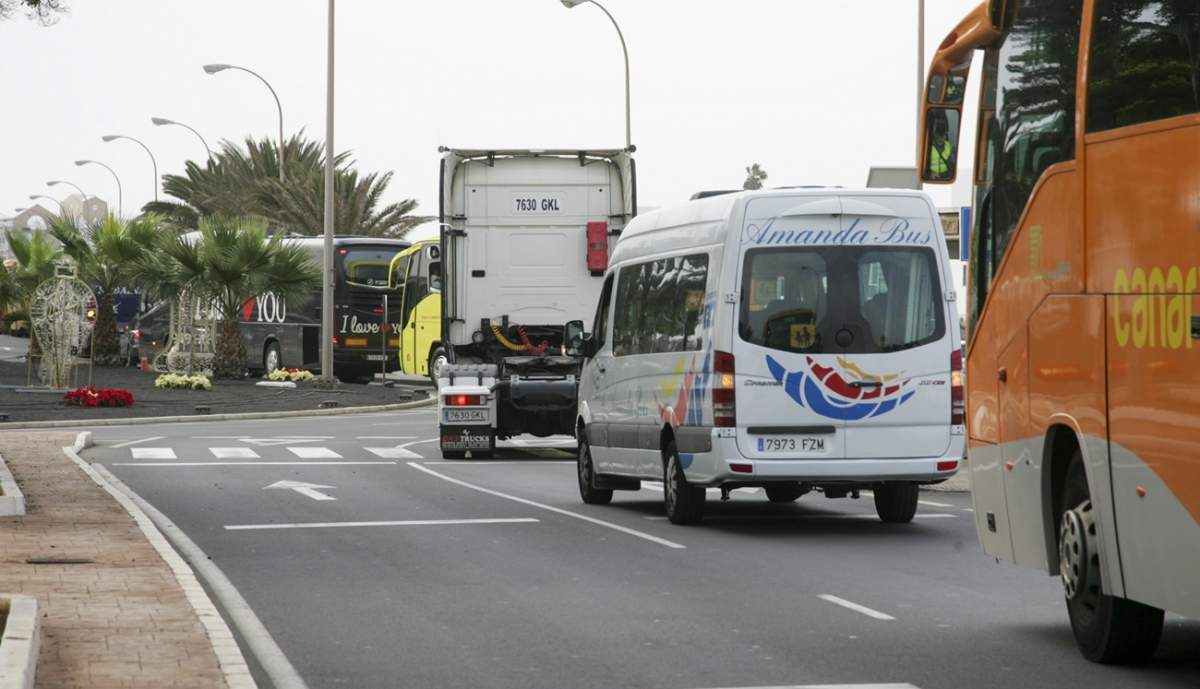
Several Lanzarote transporters have stopped their activity this Monday as a protest against the Canary Islands Government's intention to approve this Tuesday, December 17, a new regulation that changes the management of fuel aid and that they consider harms them.
Until now, the subsidies, in the form of a reduction of up to 99.9% of the tax on fuel, work by modules according to the payload of the vehicle and are returned to drivers through the Canary Islands Treasury.
Thus, for example, a driver with two trucks of 12 tons of cargo each received a monthly refund of 390 euros.
"This is a measure that was applied in the years 2022 and 2023, in this 2024 it has not been so, and we have also seen that in the general budget of the Canary Islands for 2025 not only is it not maintained, but there is also a change in the regime of application of this measure that will leave out of it around 85% of the amounts received", denounced José Ángel Hernández, general secretary of the Canary Islands Transport Companies Federation (FET).
The new system proposed by the Canary Islands Government is per kilometer for taxis and with cards for transporters that must be verified by the regional government itself.
In total, half a thousand transporters have marched through the streets of the seven Canary capitals in protest against the absence of the 99.9% refund of the fuel tax in the draft budget of the autonomous community for 2025, although nearly a thousand supported the claims.
According to the data provided by the general secretary of the (FET), José Ángel Hernández, the employers' organization has summoned about a thousand transporters throughout the archipelago, although the authorities have authorized them to take out about 500 in all the islands for security reasons.
The new system, Hernández added, represents an "economic bankruptcy" for many island transport operators and, if the situation is not resolved, could force them to "try to increase rates from January 1", despite being aware that this would mean that sectors of society "would not have the capacity to assume that increase".
The transport employers' associations and organizations are awaiting the session this Tuesday in the Parliament of the Canary Islands, in which the accounts for the autonomous community for next year will be approved, and with this pressure measure they seek to have their claims taken into account in that vote.
"We hope that the Government and all parliamentary groups will react and support the measure", said José Ángel Hernández, who added that this is a "matter of justice" because it is a fiscal measure that directly reverts to the island society and that helps them to "be competitive in 2025".
The general secretary of the FET has acknowledged that some of its associates originally asked that, instead of the marches finally convened, there be a total stoppage in the activity, although the idea was discarded considering "that in Christmas dates we could harm other business sectors".
Regarding what they will do if the draft budget is approved this Tuesday without taking into account their demands, he said that they will draw their conclusions once the day has passed in the regional Parliament.
The taxi drivers' protest
Taxi drivers have also marched through the Canary capitals who, like the rest of the transport sector, have been affected by the absence of this measure and, in their case, by the limitation of fuel aid to 5,000 liters per unit per year.
According to the president of the Unified Taxi Association of the Canary Islands, Ángel Hernández, that quota of 5,000 liters per year "becomes unnecessarily little" for most taxi drivers in the archipelago.
In statements to the media also from the Cambulloneros dock in the capital of Gran Canaria -where there were about twenty taxis waiting for the start of the march-, Hernández said that this decision of the autonomous Executive is going "to hurt us" and has defended that the problem is not the fuel they consume, "but the rights that they are going to take away from us".
"We cannot take a step back, because we are talking about any right that we have and they take away from us, perhaps we may be forced to pass it on to the taxpayer", warned the president of the Unified Taxi Association of the Canary Islands, who added that they participate in these proposals with the intention that what they have so far be maintained or that the zero tax on professional fuel be achieved.
From the FET, they have communicated that the mobilizations took place normally with the corresponding controls and protection of the forces of order, and have described the success of the call as "resounding".


