
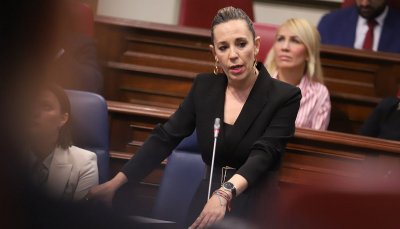
The Minister of Tourism and Employment of the Government of the Canary Islands, Jéssica de León, has calculated that the economic impact on the archipelago of the bankruptcy of the German tour operator FTI will be around 4 million euros.
De León has stated that the consequences of the bankruptcy of FTI translate into an economic impact that "will not be greater than 4 million", although there are already estimates from employers' associations for Lanzarote, around 100,000 euros, about 600,000 euros in Fuerteventura and 1.9 million in Tenerife. The rest of the islands have not yet provided data.
The debt generated with travel agencies is around 80,000 euros and with industrialists it is around 570,000 euros. It would be necessary to account for transport and other subsectors, the counselor indicated.
Jéssica de León has also explained that at the moment there are 983 FTI clients in Fuerteventura, 366 in Gran Canaria, 450 in Tenerife, 249 in Lanzarote, 125 in La Palma and 5 in La Gomera. In total, 2,078 clients "perfectly identified".
"This crisis is by no means comparable to that of Thomas Cook. That experience taught us to react in record time," she said. The last departure to Germany is scheduled for June 23.
Regarding the repercussions of the tour operator's bankruptcy on employment in the Canary Islands, the counselor recalled that FTI has 22 hotels in the archipelago, two of which are currently closed, the Stella Maris and another in Caleta de Fuste. In total, they add up to about 1,500 jobs.
In Lanzarote, the Labranda business line, independent within the parent group, has three hotels in Puerto del Carmen and one in Playa Blanca.
The counselor has also assumed that other companies of the FTI group will request the opening of the insolvency procedure and the Government of the Canary Islands must also be "attentive to the circumstances".
The German market and the summer season
Jéssica de León has stressed that as a result of the bankruptcy of Thomas Cook "many regulations changed", such as the introduction of mandatory insurance for combined travel packages, while "many suppliers do not work on credit".
She is confident that other operators will end up monopolizing the market share of the German giant, as in fact the arrival of tourists from that country to the islands for the coming months is already being absorbed by other companies.
The counselor has reported on the meetings held with the sector to urgently convene the flight development fund and to activate reinforcement promotion campaigns in Germany, and has announced an upcoming meeting with the different agents, once the impact of the FTI bankruptcy has been quantified.
All this to know what measures will have to be taken to continue with the tourist activity, to guarantee employment and so that the winter season "goes with total normality in the Canary Islands".
Jéssica de León has emphasized that the FTI crisis has revealed that "the discourse of degrowth is not real", dismantles the thesis that tourism "does not diversify the economy" of the Canary Islands, when "it is the locomotive that pulls the rest of the activities".
As an example, she has alluded to the fact that more than half of the economic impact does not fall on hotels but on the rest of the sectors and subsectors, in "companies that do not pay taxes abroad, that are Canarian", such as guides and excursions, freelancers and SMEs or waste managers.
She has also stressed that the 16 million tourists of 2023 are "not insured", because although for the winter campaign there is a 10.6% more air capacity programmed "those places have to be occupied".
Jéssica de León, who has advocated for "reconciling" the tourism industry with the Canarian residents and for seeking "real sustainability" of the sector, has added that the FTI crisis "has reminded us of what we do in this autonomous community. Let's not forget it anymore in this legislature".


