

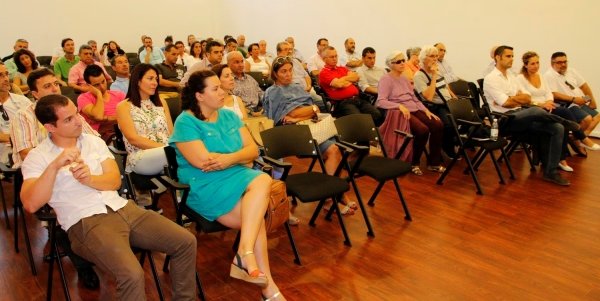
Economist José Carlos Díez presented his "Economics does not give happiness but helps to achieve it" last Friday in Lanzarote. The author gave a talk that started at 7:30 p.m. at the Playa Honda Civic Center. During the colloquium, which lasted until 9 p.m., the writer outlined the main lines of his book, in addition to giving a conference on economics and current affairs linked to Spain and Europe, with special emphasis on the possible consequences of the Greek crisis. To this he added some conditions of the Canarian and Lanzarote economy.
The book aims to explain the keys to the economy in an accessible way. "Those who want to understand what an economic measure entails will be able to do so, since these pages help each reader to be free when interpreting the economy," explained Díez.
The economist referred to the Greek crisis that has dominated the news in Europe in recent weeks. "In Greece, the corralito has already unleashed a humanitarian crisis with fierce consequences," he said. "By closing the banks, products cannot be imported from abroad, therefore medicines and basic necessities will soon begin to be scarce," warns Díez. The first thing this economist recommended on Friday is a humanitarian contingency plan. He also recalled that one in three euros that go to Greek aid is paid by the German taxpayer, so the exit from the crisis must have the support of the German people and their rulers.
Similarly, the economist warns that we will have to be "very attentive" to the risk that instability in the markets ends up affecting Portugal, then Ireland and finally Spain. "The European Central Bank has a limited capacity to maneuver, if speculative attacks are intense with doubts about the exit of the euro from the Greeks, Europe and Spain may have a very bad time." In addition, he recalled that in previous crisis situations with the governments in 2010 of Zapatero and Rajoy in 2012, the risk premiums exceeded 400 and 600 points, respectively.
"Lanzarote is unique"
José Carlos Díez also referred to Lanzarote. "You live on a privileged island," he told the attendees. "I have visited the five continents and have found wonderful places, but Lanzarote is unique, its lunar landscape is wonderful and unrepeatable."
For the economist, we should not be "so obsessed" with the number of tourists, but rather "the key" is the average expenditure per tourist. During the talk, he also encouraged citizens to fight to continue preserving the island, as Manrique once expressed. To conclude the meeting, José Carlos Díez signed copies of his book for the readers and exchanged opinions with the public who attended the event.


