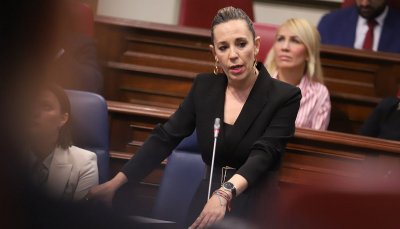
The Minister of Tourism of the Canary Islands Government, Jéssica de León (PP), has asked this Thursday for "urban planning discipline" from the Canary Islands city councils to organize holiday homes with the mechanisms offered by the new law on tourist housing.
De León made these statements at a press conference in the Parliament of the Canary Islands after symbolically handing over to the President of the Chamber, Astrid Pérez, the text of the law that will regulate tourist housing in the Canary Islands and that must now be processed in the Chamber and submitted to possible modifications by the rest of the groups.
Thus, she has defended that "the law offers tools to the city councils and councils to adequately plan the use of holiday homes without the need to modify the general planning plan, which is a much more complex procedure."
"The City Council of Granadilla, with a one-and-a-half-page ordinance, has made it very clear what it wants in its municipal area," exemplified the Minister, who insisted that this urban planning discipline "plays a fundamental role."
"It is useless to have a planning if the compatibilities of the uses with the ordinance are not analyzed and if its own rules are not complied with. This is what happens with Las Palmas de Gran Canaria," she criticized.
In the opinion of the Minister, the situation of the Canary Islands with respect to tourist housing and the organization of the sector has been reached "with moratoriums and without planning", so they have seen themselves in the "responsibility" of introducing corrective mechanisms so that the law can be assumed by all the actors involved.
Asked if she was concerned that the announcement of the law had led to an increase in the registration of homes for tourist use, De León denied that "the increase is considerable" and warned those who make the responsible declarations to register that "they will not be consolidated the right of exploitation if they do not meet the requirements or if they do not exercise the activity after one year."
Regarding the control methods of the responsible declarations, De León referred to the need to "understand the areas of competence" and pointed out that the Autonomous Community has the competence of inspection and has 35 inspectors for it, although it can make use of entities such as the college of registrars or tools such as the agreement with reservation platforms, such as Booking, to cross-reference the data of the registry with those of the advertisements and "remove all illegal offers from the platforms."
"The councils have entrusted the revisions of the responsible declarations and will have to verify that they are complied with. The city councils have tools such as the urban planning offices and the local and regional police, which have powers in tourist areas. A coordination work of all the levels with competence in the matter is necessary so that the whole of the activity of the tourist industry is controlled," she delved.
On whether the agreement with Booking was going to be extended to other platforms more focused on holiday homes such as Airbnb, De León has asserted that they are working on it and that she "appreciates" the change of position of Airbnb regarding the law, since the introduction of the regulation of digital platforms in the European Union "is allowing a better and more fluid dialogue with the platforms."
Likewise, De León has recalled the social function of housing and has pointed out that, therefore, an obligation is established that homes have that function during their first ten years to satisfy the needs of the Canarians "who have the right to have decent, affordable and adequate housing."
"The law responds to the general interest but also to the tourist interest that holiday homes undoubtedly have, which represents 39% of the accommodation offer and which is a modality that is here to stay and that the Government of the Canary Islands supports, but that needs a rule that regulates and balances the sector and obeys the citizen mandate to balance the tourism industry with the well-being of the resident," she summarized.
The Minister of Tourism has said that "the reality of the 88 municipalities is different and also of each island, so the law offers the possibility of designing 88 different strategies in the image and likeness of the municipalities, having as a backbone the general interest of the 2.2 million Canarians."
Regarding the contributions of the parliamentary groups, the Minister has lamented that, after requesting a meeting to present the law and listen to their proposals, they did not receive a response. "Surely it is a mistake," she added.
She has also lamented the relationship with the Canary Islands Association of Holiday Rentals (Ascav), with whom she has said that it is "difficult" to have a relationship of loyalty after some episodes in which, according to the Minister, Ascav has leaked some things to the media or sent press releases with the content of meetings while those meetings were in progress, something that "prevents a fluid dialogue."
De León asks municipalities for "urban planning discipline" to organize holiday homes in the Canary Islands
The Minister of Tourism of the Government of the Canary Islands has defended that "the law offers tools to the city councils and councils to adequately plan the use of holiday homes without the need to modify the general planning plan
February 6 2025 (13:45 WET)