
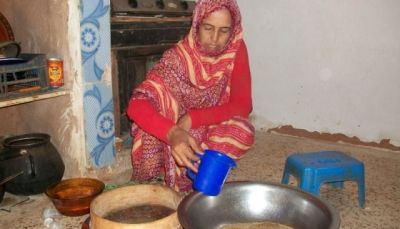
"Mariah gets up at seven and goes to a nearby haima to collect the couscous with which she wants to honor us. We are her guests for a week in the Sahara desert, in the southernmost camp of the dry and stony Algerian hamada.
She has already wrapped her body in a brightly colored melfa, which seems to act as a protective barrier against discouragement. She is forty years old and her face is furrowed by all the roads that lead to Dakhla.
Although she doesn't talk about it, I can imagine her at the age of five, holding the hand of a dark-skinned and robust father, making the last trip of her people, nomadic and free as the Sirocco, before being tied to the dunes of a neighboring country.
The golden couscous that Mariah seasons has been made by one of her many cousins. It is not strange. In the Sahrawi refugee camps, endogamy is almost obligatory, forced by exile and isolation; at most, they manage to relate to each other between the different wilayas, as happened in Spain fifty years ago in the inland villages, in the mountains or on the islands.
In any case, it never fails to bring a smile to our faces every time they identify any of the visitors who enter and leave the haima as "cousin". Both from a metaphorical and real point of view, the Saharawi people constitute a large family. And for a week, we are part of it.
Mariah plunges her hands into the large metal fountain and lets the grain slide between her fingers. She does it several times, to loosen the whole wheat shavings. Then she passes them through a sieve and covers them with water.
The couscous absorbs every last drop, without being satisfied, as the operation will have to be repeated several times throughout the preparation of the dish. It seems as thirsty as the inhabitants of the desert, many of whom keep in their memory the memory of an immense and generous ocean at the foot of their cities.
They have dug into the sand on which they live, which to our surprise contains abundant and clean water. They have dug wells that allow them to irrigate their Extremadura orchard (financed by that community), produce vegetables for self-sufficiency during the less hot months of the year and maintain hygiene according to their dignity. But the hundreds of latrines that stand outside the haimas and adobe houses constitute a threat that no one seems to see.
In half an hour, the grain seems completely dry. Mariah adds salt and a splash of oil, stirs the mixture with her hands and fills the steamer of a large pot with it, the bottom of which is covered by a piece of purple melfa to prevent the grains from escaping. -The cloth has to be very clean, -she warns through her daughter Salka, who translates the steps to prepare the recipe for us.
While cooking begins, Dahba, the other teenage girl in the family, engaged, talkative and attached to her cell phone like any Western girl of her generation, appears with the small table and the equipment for preparing tea.
The drink, bitter with life, sweet as love, soft as death, is an essential accompaniment to the lives of the Saharawi people. In the situation of interim, of parenthesis in which they live, -because they refuse to accept that it is definitive-, time drags on slowly. And the ceremony of preparing the infusion seems to fill all the gaps.
Although during the first days we considered it a sign of courtesy and accepted to dedicate the hour of our meager time in Dakhla that each tea requires, we realize that it can be interrupted after the first or second of the three and requested at any time of the day. And the ceremonial of the dance of containers on the tray, the golden liquid poured from glass to glass, the delicious tea, is always just as hypnotic.
Mariah calls us back to her kitchen to witness the continuation of the recipe. Squatting on the floor, she slaps the couscous so that it loses heat and becomes fluffy. She sprinkles it with water and continues the process for a few minutes. Then she covers it and puts water to boil to repeat the steaming.
The morning advances lazily in a place completely alien to the hustle and bustle of our daily lives. Without obligations beyond the purely domestic, -going shopping, removing every last vestige of desert dust from the carpets, cooking or washing clothes-, young Saharawis feel they are wasting their lives.
Some of them, like Jama, have traveled to Cuba to train, thanks to the agreements between the Polisario Front and the Castro regime. But on his return, neither his preparation nor the hobbies cultivated in that country have a place in the desert. Jama is an engineer but teaches Spanish in the February 27 camp. Jama dances in a café to the rhythm of reggeaton, moves his hips with Caribbean cadence and displays a huge smile to the wide-eyed audience that we make up.
Jama has grown up surrounded by water, in a world without limits, and is condemned to live between military controls, with the life he longs for on the other side of a wall protected by machine guns and anti-personnel mines.
The couscous is ready. Fifteen last minutes on the fire have finished giving the point to the whole wheat semolina, which will be accompanied by a camel and vegetable stew. The ones that can be obtained that day. Today, zucchini, onion and tomato".


