
Anyone who has approached our museum or exhibition institutions will agree with me that these are small, complicated and have become obsolete with respect to contemporary needs. These have remained unchanged with hardly any modifications or extensions since the eighties of the 20th century. It is time for us to weave in our own, vernacular and diverse way the spaces that will host the art of the present and the future. The very important contribution that the plastic and visual arts have had in the development of the image that Lanzarote projects to the whole world is undeniable. The island cannot be understood without the indivisible binomial of art and nature.
We are witnessing how the generation born after the nineties, claims its role in the space and public discussion, determining an axis of action from the meaning of living or connecting with this island in relation to a world that is glimpsed in perennial crisis. That is why they seek to return to the primary and elemental, to what happens in the dynamics of daily relations or in the territory with which they connect.
The curator of the exhibition Marianna Amorim, who is also an anthropologist and artist, says that the fact of growing up and living in Lanzarote, where the landscape invades everything, makes those of us who create from here look at the territory from a experiential way. I couldn't agree more with this statement and I add that I see in them a responsibility and social sensitivity that makes their works directly reflect on community aspects, so important to continue building our universal idiosyncrasy.
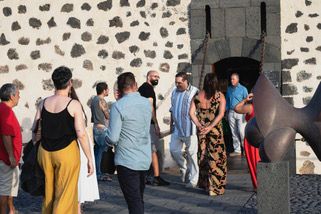
Undoubtedly, this exhibition marks a milestone to take into account when structuring future exhibition programs and projects. Since 1976, the year of the opening of the MIAC (International Museum of Contemporary Art), no local artist had exhibited in The Hall of the Permanent Collection. The inauguration was attended by three hundred people of all ages and backgrounds, forcefully demonstrating the interest of the island's population in the projects and exhibitions that are developed from their own perspective. Once and for all, we are deconstructing our prejudices and turning around "everything from outside is better than Lanzarote" to reveal an idea that is not new, but that sometimes runs the risk of remaining in embers; "The culture created and developed in Lanzarote has the power and entity to dialogue on equal terms with other territories, becoming universal through the eyes of the millions of tourists and visitors we receive from all over the globe."
The exhibition dialogues directly with the historical memory of Lanzarote, by linking directly with the work of Pancho Lasso, which the MIAC preserves and disseminates as the heart of the museum's collection. Our most important sculptor, father of Lanzarote's modernity, was able to develop his activity and studies since he was the first scholarship holder in the history of the Cabildo Insular de Lanzarote in 1926, allowing him to access essential knowledge and resources that led him to create from his own and telluric. The support, training and production program "The diverse museum" welcomes that spirit adapting it to our times, aims to be an oxygen balloon that fights against the precariousness that often lives the cultural sector, to contribute to generate the looks that will create from Lanzarote to the world.
As much as sometimes we try to transform our island into a metropolitan street of some European city, our reality is not linked to individualism, but to community ties. That is why this project has been concerned with promoting relational dynamics between the artists, in order to establish dialogues that promote thought, debate and reflection, matrix concepts of artistic creation. I am sure that this program can be implemented periodically and will contribute directly to the improvement of our cultural fabric.
If you can, come to the MIAC to enter "the backyard", a suggestive exhibition proposal resulting from the project "The diverse museum", which invites us to appreciate the works of the painter and illustrator Marina Speer, the sculptor Cintia Machín, the interdisciplinary artist and fashion designer Darío Machín, the painter and textile artist Mariela García, the illustrator and writer Lana Corujo and the curator, anthropologist, doctor in art and philosophy and artist Marianna Amorim.
Note: The information of Pancho Lasso has been collected from the research work of the historian Arminda Arteta and the designer Vanessa Rodríguez. The photographs have been taken by the artist Adriana Sandec. In the training sessions have participated different cultural agents such as the painter Daniel Jordán, the director of the MIAC María José Alcántara or the cultural manager, writer and artist José Betancort. In the exhibition assembly have participated the workers of the Centers of Art, Culture and Tourism as well as the families of the participating artist. The inauguration was attended by public representatives of the Cabildo de Lanzarote. They have contributed to the successful development of the project: Daniel Fleitas, María Marta Neme, Amparo Perdomo of Radio Insular del Cabildo de Lanzarote, the programming collective and Arduino Lanzarote Makers and the Casa de la Cultura Agustín de la Hoz de Arrecife.
J. David Machado Gutiérrez Expert in contemporary culture.
Add La Voz de Lanzarote as a preferred Google source.
Stay informed with the latest current news.