
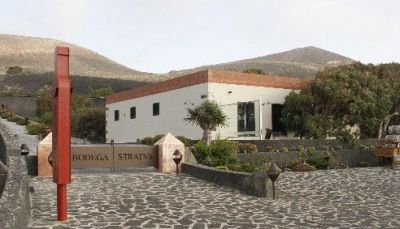
The Special Plan for the Protected Landscape of La Geria has "defects of nullity and illegality" ranging from the procedure followed for its approval and the lack of mandatory reports, to the treatment given in the document to the Stratvs winery. This is what Leopoldo Díaz, who until last Friday was the director of the Island Plan Office, maintains in a report that had been kept hidden until now, but which triggered his dismissal by the president of the Cabildo, Pedro San Ginés.
The report that La Voz has now had access to was commissioned last January by San Ginés himself, who intended to counteract the devastating expert opinion made by another Cabildo lawyer, Joana Macías, at the request of the Court that is investigating the Stratvs case (to determine if the winery would be legalizable with the new La Geria Plan). However, far from disagreeing with this lawyer, Leopoldo Díaz showed his "essential agreement with the central legal issues addressed" in that report and was even more forceful if possible in his conclusions.
In his writing, dated last April, Leopoldo Díaz began by clarifying that his opinion "is not a complementary, added or clarifying expertise of the one signed in court, because who has requested it is the president of the Cabildo" and not a judge. In addition, he even emphasized that the independence of a technician who acts as an expert in a Court is protected by law, and it could be a crime to try to influence their conclusions, as also recalled at the time by the judge of the Stratvs case, Silvia Muñoz, in an order where she referred to a writing that Pedro San Ginés had sent her, in which he questioned the report of Joana Macías. Publicly, the president has always assured that the "legal services" of the Cabildo did not share that opinion of Macías, although the truth is that the jurist who for 20 years has been in charge of the PIOT Office maintains exactly the same thing.
An "substantial change" without justification and without going to public display
Throughout a report of 31 pages, Leopoldo Díaz analyzed the different "defects of nullity" in which he considers that the controversial Special Plan of La Geria incurs, definitively approved by the Government of the Canary Islands last July. And among them, he highlighted the case of the Stratvs winery (built illegally and without permits to protect that work), because during the processing of the Plan the use of that land was modified, without justifying the reasons for this decision and without even submitting that change to public information.
"Between the Advance and the Partial Definitive Approval there was a reclassification of land that implies an environmental deprotection of natural resources for the benefit of economic exploitation", Leopoldo Díaz maintains in his report. Specifically, in the first documents that were submitted for approval, the land where Stratvs is located appeared as "rustic of landscape protection", which does not allow infrastructures like this. However, in the last procedure the category was changed and it became "rustic land of agricultural landscape protection". And that nuance, means that it can house a winery, since the Canarian law allows these facilities in agricultural protection land. Without that change, "Bodega Stratvs could not be installed on the land where it is located today", concludes Leopoldo Díaz in his report.
In any case, the report also points out that despite the changes contemplated in the Plan, the winery would still not be legalizable, since it also does not comply with the "urban parameters" established in that document ("it does not comply with the minimum plot, buildability, meters built above ground, maximum height and setbacks"). Precisely some of those "parameters" are those that are also intended to be varied now with the modification of the La Geria Plan, which at the end of the last legislature was taken to Plenary on three occasions by Pedro San Ginés without getting it approved.
In his report, Leopoldo Díaz also questioned that the "reclassification" of the Stratvs land "that occurred between the initial approval and the definitive approval of the Special Plan of La Geria" was done "without submitting to the public information procedure", despite the fact that it was "a substantial change", so he warned that this entails "cause of radical nullity of said planning".
In addition, he stressed that this change was made based on the same territorial information that served to support its initial categorization and added that the Special Plan's Report was not modified either. In this way, such a "determining or substantial variation is devoid of any foundation, with flagrant omission of the duty to motivate the change of criteria and without new public information, subtracting from citizens and administrations the opportunity to allege what suited their legitimate interests".
Stratvs, like historical wineries and the Farmer's Monument
Regarding the land use of Stratvs, Leopoldo Díaz added that in the last approval process of the La Geria Plan, the land of this winery of the businessman Juan Francisco Rosa changed again, becoming considered a structuring equipment, together with the Farmer's Monument and all the historical wineries of La Geria.
The former head of the PIOT Office warned in his report that this new category introduced by the Special Plan allows "the promoter to delimit at will and free will that rustic land for the protection of infrastructures and equipment".
In addition, also coinciding in this with what Joana Macías already raised in her expertise, Leopoldo Díaz concludes that "the Special Plan of La Geria cannot implement structuring equipment", since "only the Island Planning Plan has legal authorization to do so", so he considers that this figure created by the Plan also has no legal coverage.
"It is not a report from the Cabildo, but from a judicial expert"
When last January he requested this report on the "legal considerations" made by the lawyer Joana Macías in her expert opinion, Pedro San Ginés argued that he did so "attending" to the "repercussion" that this report could have "on the authorization acts that are being reported by this Cabildo", given that there was talk of "defects of nullity" in the La Geria Plan, which was approved by the Government of the Canary Islands. "He has put the entire Corporation at the feet of the horses", San Ginés publicly said then.
In this regard, Leopoldo Díaz responds in his report that the opinion of an expert (which is how Joana Macías acted when responding to the Court's request) "does not bind the Cabildo" and only "has effects in the criminal scope and framework in which it has been requested and issued, without affecting the authorization acts processed by the Island Council of Lanzarote". "It is not the report of the Cabildo, but of a public employee of the Cabildo who acts as a judicial expert", clarified the former head of the PIOT Office.
In this regard, and as an example, he recalled that the director of the Legal Advice of the Cabildo defends as a lawyer one of the technicians of the Cabildo accused in the Stratvs case, specifically the engineer of Classified Activities, and during the instruction of the case he even adhered to the request of the private prosecution and the Prosecutor's Office, demanding the precautionary closure of the winery. "That does not imply that the island entity maintains such a position or that that is its own", underlines Leopoldo Díaz in his report, citing this example to insist that the Cabildo has nothing to do with what its technicians, officials or workers do at the request of a judge or in the instruction of a case in which they intervene.
"Eventual non-application of the Plan by judges and courts"
Regarding the validity of the La Geria Plan, Díaz responded to the president that not even the report of Joana Macías calls it into question. And it is that although it has "defects of nullity", the document can only be annulled by a court or by the administration itself, if it decides to review the document ex officio.
Therefore, he concluded that while that does not happen (the Plan already has several appeals in the courts), the document "is in force, is part of our legal system and is fully applicable". In any case, he added that "another thing is that the defects of nullity and illegality of the Special Plan that the report maintains open the door to its eventual non-application by judges and courts" (for example in the Stratvs case), since the Law establishes that these "will not apply regulations or any other provision contrary to the Constitution, the law or the principle of normative hierarchy".
As for the Administration, Leopoldo Díaz also clarified that one thing is that the La Geria Plan is in force today, and another is that "it can be applied as if it were a legal island". In this regard, he clarified that the planning system of the Canary Islands "is governed by the principle of hierarchy", so he stressed that in case of contradiction, the one that "prevails is the Island Plan". At this point he again disagreed with the document of the La Geria Plan, which in the justification report maintains the opposite, stating that since the PIOT is not adapted to the Guidelines of the Government of the Canary Islands, the La Geria Plan would prevail. According to Leopoldo Díaz, it is "unfounded to maintain" that and "there is no precept that supports such a blunt assertion".
In the PIOT, the Stratvs land is "classified and categorized as rustic land for protection: areas of landscape value-unique landscapes". This category, according to what the then director of the Island Plan Office pointed out in his report, is intended to protect the visual quality of an area and its crops, and the Island Plan establishes that "the construction of buildings and aerial infrastructures are incompatible with its conservation, as well as any work that requires earth movements".


