
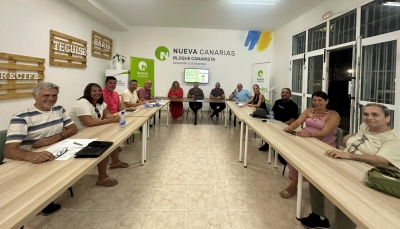
Nueva Canarias-Bloque Canarista (NC-bc) in Lanzarote and La Graciosa wants to point out the importance of updating and approving the municipal emergency plans (PEMU), which on the island of Lanzarote has only been ratified in full by the municipality of San Bartolomé. These plans were approved in 2019 by the Civil Protection and Emergency Care Commission of the Canary Islands, an organization made up of the Administration of the Autonomous Community of the Canary Islands, the General State Administration in the Canary Islands, the island councils and the Canary Islands municipalities.
For the Canaristas, the updating and approval of the PEMU is essential to have adequate prevention in the face of contingencies that may occur, both natural and derived from human action. That is why, says Yoné Caraballo, island president of the organization, that "the municipalities must and have to do their homework in terms of prevention and planning of responses to emergencies, given that we are going through major meteorological and public health changes that force us to reinforce the public and civil protection response."
"The La Palma volcano, the Covid pandemic or the Valencia DANA show us that we are facing a historic moment of great changes and adverse phenomena that require demanding and scientific public planning that aims to provide security to our citizens and mitigate the damage we may have," says Caraballo, who believes that "historically in Lanzarote there has been little consideration for prevention, since we are used to the fact that nothing serious ever happens that forces us to have more resources and personnel than those available."
Caraballo recalls "that the times we have suffered extreme events such as rains or traffic accidents with several victims, the emergency and health teams have had difficulties in dealing with these situations, which they alleviate due to the great professionalism they possess." He gives a practical example of how the emergency teams are on the island: "we don't even have the capacity to deal with a micro bus accident."
The Canarist deputy highlights that the equipment endowments in emergency teams are precarious, although they have been supplemented with professionals such as EMARLAN who do a commendable job of reinforcing the public Emergency Consortium. He also mentions that we cannot continue with empty promises or half-truths, such as the latest from the president of the Cabildo de Lanzarote, Oswaldo Betancort, announcing the purchase of a rescue helicopter that will finally not be purchased.
Canary Islands Emergency Agency
NC-bc proposes that the Government, the island councils and the Parliament define a strategy to update the 1998 Security Plan and establish a Canary Islands Emergency Agency within six months. This public body will have powers throughout the Canary Islands territory and will cover the promotion and control of emergency plans, rescue and salvage services, the management of the Canary Islands Emergency and Security Coordinating Center 112 (Cecoes), the maritime rescue service, beach safety and firefighters.
The creation of a Canary Islands emergency agency, in the opinion of the Canarist group, is a "viable solution to improve the response and coverage" throughout the autonomous community. In addition, it has full statutory coverage, since the 2018 Statute of the Canary Islands gives more powers to the community in terms of civil protection and maritime rescue, which allow greater independence in the regulation and execution of security measures in the civil sphere.


