
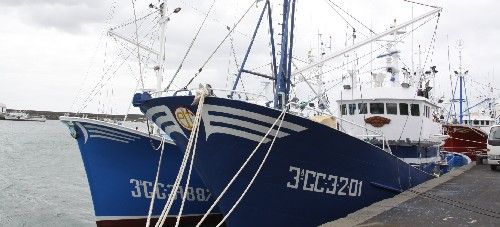
The San Ginés fishermen's guild has gone from having a fleet of 300 boats to gathering no more than 100 vessels. The decrease in the number of boats comes from the drop in catches, which do not reach even 20 percent of what they once were.
Since 1999, the sardine stopped entering the port of Arrecife as a result of the breakdown of the agreement with Morocco, so inshore catches and tuna catches are now the only object of work for Arrecife fishermen. Once the canning industry disappeared, the professionals of the sea go out to work in search of fresh fish to supply the fishmongers and restaurants. They continue to bring groupers, antoñitos, old fish, comber or sargos, but the quantities have decreased significantly.
Port management
There are other problems that add to the scarcity of marine resources, according to the administration and the guild itself: the way of managing the port, the inefficient fisheries control, and sport fishing. As far as the management of the port space is concerned, currently the guild manages the slipway, but the fishermen of San Ginés fear that the Port Authority will transfer this assignment.
This is confirmed by Pérez, who assures that "in the next concessions that are going to be made, the guilds will not have an option, so they will have to pay to use it." The sailors want to continue managing this space and the councilor believes that "a model should be sought to which fishermen can opt, something that I have proposed to the vice-councilor and that I hope he will take into account; and if not, at least put an affordable price."
Fisheries control
Another aspect that afflicts the fishermen of Arrecife is the lack of surveillance that is carried out in the waters of Lanzarote. To this day, the control of the sector is carried out by a boat with two professionals on board dependent on the Environment and, in the opinion of the workers of San Ginés, this is not enough since "boats from the North come here to fish and enter our internal waters and have no consideration for anything," says Soto.
Those from Arrecife can work the twelve miles closest to land and the non-Lanzarote boats fish in mile 12.1 so "these ships are taking fish that could enter our waters," criticizes Pérez. The councilor proposes as a palliative measure to coordinate all surveillance systems. Because "the Cabildo cannot increase the troops in these times of recession," the Fisheries coordinator suggests that "Seprona, Environment and the locals coordinate to improve control with the same item."
Sport fishing
And the other complaint that the men of the sea shout to the wind is the proliferation of sport fishing. Those of the guild assure that there are amateur fishermen who catch fish without passing the first sale controls. In fact, they denounce that "they are made the control of the first sale, but then there is no surveillance in hotels or restaurants to see where they get the fish; and there are many retired and sports fishermen."
Nereida Pérez, from the administration, recognizes this problem and comments that "the sport fisherman goes out and has the right to catch a few kilos of fish for their own consumption not to sell it, but if a hotelier or housewife buys it, the administration has nothing to do." That is why she proposes the implementation of "a market where the control of the first sale is carried out and we would avoid much that poachers have a place; of course, if there are non-professional fishermen who catch catches and sell them in the restaurant on the corner, little can we do if the hotelier buys it."
Where to fish
Lanzarote ships fish in Canarian waters, in the Moroccan fishing ground and there is also a boat, the Cima de Oro, which works in Madeira waters from April 15 to 24. By law, the conejeros sailors can work less than 12 miles from the islands, according to the Canary Islands Water License; less than 20 miles from the Spanish coast, according to the National Water License; and more than 500 miles from any coast according to the stipulation of International Waters.
To these licenses is added the agreement with Morocco, which contemplates the fishing of the professionals of the island in the Moroccan fishing ground from 2006 to 2010, and an agreement signed with Madeira by which three Canarian ships chosen by lottery can work in its waters. One of these boats is from the San Ginés Guild and two others are from Tenerife.
Despite these rules of the sea, the truth is that the Lanzarote people only work in Canarian waters since moving too far from their ports makes the effort to achieve the catches unprofitable, so they only work in the waters of the islands and in the Moroccan waters.
From port to scrap yard
With all these problems on the table, the fishermen assure that their sector tends to disappear. "The tuna fleet is tending to disappear, if there is no fishing this year we do not know what is going to happen. What is clear is that the primary sectors of agriculture and fishing have been loaded," laments Garrido. "We are talking about the fact that before there were 300 boats and now there are only 100 between tuna, inshore and artisanal," emphasizes the secretary of the guild.
Juan Morales Hernández, a graciosero skipper who has been working at sea since 1965, assures that the situation "is getting worse and worse". "Every year the amount has been decreasing. The departures are the same, but now we do not bring even 20 percent of what we brought before. We have government aid, but it is not enough to cover the expenses; I stay unemployed for five months a year and then I dedicate myself to the maintenance of the boat. The activity decreased in 1999 with the end of the sardine. I had three boats, and now I have a tuna boat," explains Hernández.
The shipowner of another tuna boat, Javier Toledo, has had a similar trajectory to that of his partner. He explains that he has been a shipowner for 14 years because his father had boats, but as a result of "the rise in oil, contributions and the decrease in catches," he is clear that if the tuna season does not go well this year, he will remove the boat if they approve the scrapping."
And, according to Toledo, "the profits are not enough to pay the social security of those who go on board." He attributes the state of the sector to the fact that "all the reproducers were killed less than two miles away and they loaded the Moroccan fishing ground. Before there was balance, but by putting boats to work along the shore they killed the reproducers."
Diversify the product
Despite the decrease in quantity, the possibility of selling the catches when they reach land is still very wide. As not much merchandise enters, "the fish is sold almost before fishing it to restaurants and hotels," emphasizes María del Carmen Soto, secretary of the Guild. Thus, the great demand in Lanzarote becomes one of the advantages of the sector on the island, as recognized by Nereida Pérez, Councilor for Fisheries of the Cabildo de Lanzarote, when stating that "the strength we have is that we have a good market thanks to the high consumption we have at local level."
At this point, the amount of fish swimming less than 12 miles from the coasts of Lanzarote cannot be increased, but there are possibilities to boost the sector. Nereida proposes as a solution to give added value to the product that enters the port. In this line, she is committed to the diversification of the sector and introduce fish handling for this purpose.
In the opinion of the councilor, it would be convenient to "make fillets and packaging to be able to diversify the economy, because now what they do is pack it whole and put the tuna in boxes to send it by plane; that is why I believe that aid should be focused there trying to diversify the product a little."
The councilor proposes, for example, "packaging the minced tuna with oil." In her opinion, the diversification of the product "does not have to be a great manipulation, it is only about adapting to the needs of society that becomes more and more demanding and offering them a new product," adds the councilor.
RELATED NEWS
[Everyone's fault, no one's fault->26806]
[Making ice or handling fish?->26807]


