
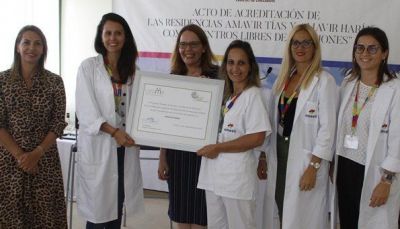
The residences for the elderly in Tías and Haría, belonging to the Cabildo of Lanzarote and managed by the company Amavir, received this Wednesday the national accreditation as 'Centers free of restraints', granted by the Spanish Confederation of Organizations for the Elderly (CEOMA). According to the institution, "they are the first centers in Lanzarote to obtain this important recognition, which in all the Canary Islands only three other residences have (two in Tenerife and one in Gran Canaria)".
The award ceremony, held in the senior center of Haría, was attended by the Minister of Social Welfare of the Cabildo of Lanzarote, Maite Corujo (PP); the mayors of Tías and Haría, José Francisco Hernández and Marci Acuña, respectively; the technical director of the 'Desatar' program of CEOMA, Antonio Burgueño; and the deputy general director of Amavir, Lourdes Rivera.

The accreditation as 'Centers free of restraints' is achieved after three years working within the framework of the program 'Unleash the Elderly and Alzheimer's Patient' of CEOMA, and certifies that in these centers they work "without any physical or pharmacological restraint that limits its residents".
In this sense, and after congratulating the staff of both centers and thanking them for "their effort", the island councilor for Social Welfare, Maite Corujo (PP), pointed out that the Cabildo of Lanzarote "will continue to bet on eliminating barriers that limit the freedom of human beings".
"Erroneous belief"
According to Antonio Burgueño, "historically Spain has been one of the countries with the highest percentage of use of restraints in residences for the elderly, establishing the belief that these restraints provide greater security and contribute to preventing falls, but the evidence shows that this belief is erroneous and that the risks that restraints entail for the quality of life and dignity of the elderly and the physical and psychological benefits that their withdrawal brings are not taken into account".
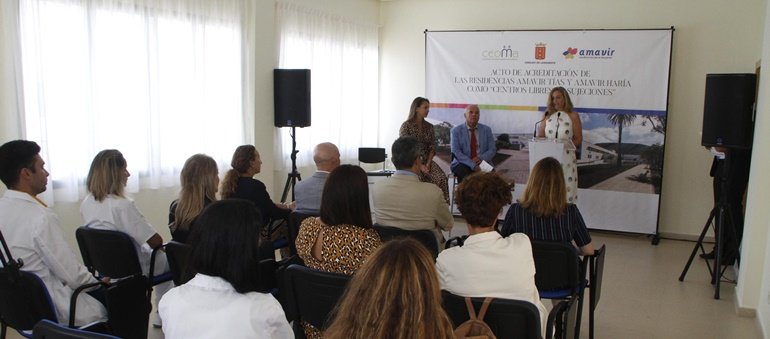
For her part, Lourdes Rivera explained that, for the development of this program, Amavir has carried out training and awareness-raising tasks for both professionals and family members, which began with a diagnosis of the situation and a detailed analysis, case by case, of all the residents who had restraints and a proposal of alternatives. In addition, it has also involved the adaptation of the environments of the residences and the acquisition of materials, such as ultra-low beds, special armchairs, mats, etc., to be able to work according to the characteristics required by each user.


