
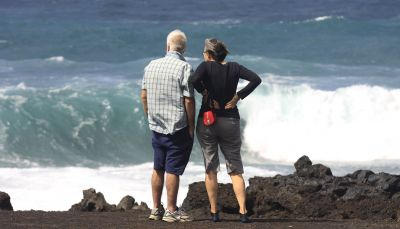
The Government of the Canary Islands has asked that precautions be taken on the coast of the islands, and to avoid bathing on the beaches and walking along the coast, given the alert for coastal phenomena that will come into effect at 8:00 p.m. this Friday due to waves of up to 5.5 meters high.
This situation will affect the entire coastline of the islands, especially the coasts facing north and west, so the Government of the Canary Islands asks the population to take extreme precautions in order to avoid relevant incidents and follow the self-protection advice issued by the Canarian Executive to avoid added risks.
The most affected areas of Lanzarote will be the north and west coast, affecting the municipalities of Yaiza, Tinajo, Teguise -including La Graciosa- and Haría.
The forecasts point to bad sea conditions, mainly due to north and northwest swell with waves that will probably reach and exceed 4 to 5.5 meters in height, with Sunday being the day when the largest waves may occur.
This bad sea state poses a very important risk for bathers and for infrastructures that may suffer damage derived from the strong waves, the Ministry of Territorial Policy, Territorial Cohesion and Water has indicated in a statement.
Therefore, it is very important to avoid bathing on the beaches, especially if they are secluded or do not have surveillance, and postpone nautical and sports activities for another occasion when the sea state is good.
Likewise, the population should avoid taking walks along the coast and driving vehicles on roads near the beach line, as well as not staying near the sea if there are strong waves or approaching it, even if it calms down suddenly.
"We must never forget that we are on alert for coastal phenomena and that the behavior of the sea is unpredictable," the Ministry warns.
When it comes to carrying out some type of air rescue, the Government of the Canary Islands recalls that in the current season the days are shorter and it gets dark sooner, which considerably shortens the action time of the rescue helicopters in case their intervention is necessary.
The areas with the highest potential risk in the face of this alert for coastal phenomena in the province of Santa Cruz de Tenerife are the north and west coast of La Palma (Puntallana, San Andrés y Sauces, Barlovento, Garafía, Puntagorda, Tijarafe, Tazacorte, Los Llanos de Aridane and Fuencaliente); and the north and west coast of El Hierro.
It will also affect the north coast of La Gomera (Valle Gran Rey, Vallehermoso, Agulo, Hermigua and San Sebastián de la Gomera) and the north coast of Tenerife (Buenavista del Norte, Los Silos, Garachico, Icod de los Vinos, La Guancha, San Juan de la Rambla, Los Realejos, El Puerto de la Cruz, La Orotava, Santa Úrsula, La Victoria, La Matanza, El Sauzal, Tacoronte, La Laguna and Santa Cruz de Tenerife).
In the province of Las Palmas, the most complicated situations will occur on the north coast of Gran Canaria (Agaete, Gáldar, Santa María de Guía, Moya, Arucas and Las Palmas de Gran Canaria); on the north and west coast of Fuerteventura (Pájara, Betancuria, Puerto del Rosario and La Oliva).


